Google
 
Showing posts with label konkani (amchi). Show all posts

December 25, 2012

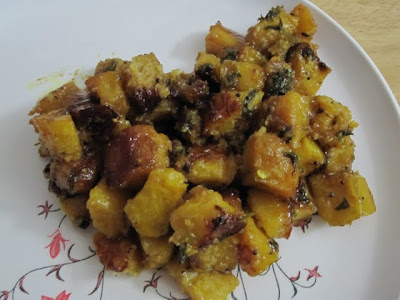
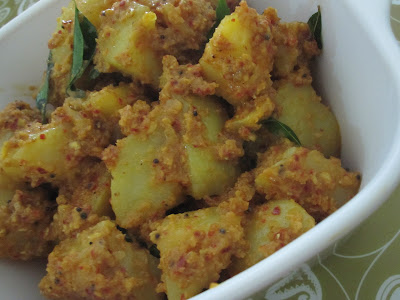
Batata Sukke


Potatoes. A vegetable used as often in my house as many others. Many people tell me that they use a higher proportion of potatoes to other vegetables. In our household, that vegetable would be carrots (or peas). It is not that anyone here dislikes potatoes, everyone loves them.  I just don't always think of  the potato as a vegetable in its own right.

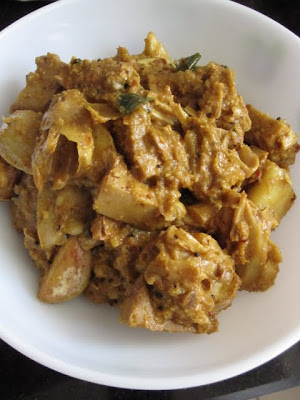
This year, for Ganesh Chaturthi, I made the entire amchi spread. We did our puja with somashe, modak, chakli, patrodo, dali saar, karatye ghasshi, phodiyo, etc. It was a huge spread for just us, but I went ahead anyway. One of the dishes that goes into this traditional feast is Batata Sukke.


1/4 kg Potatoes, cooked, peeled and cubed
1/2 tsp Urad Dal
1/2 tsp Fenugreek Seeds
1/2 tsp Coriander Seeds
1 tsp Oil
1/4 cup Coconut
3-4 Red Chillies
1 tbsp Tamarind Paste
1/4 tsp Turmeric
Salt to taste


For the tempering:
1 tsp Oil
1/4 tsp Mustard Seeds
1/4 tsp Asafoetida
7-8 Curry Leaves


Heat the oil and fry the fenugreek seeds and the coriander seeds for a minute. Grind this along with the turmeric, tamarind, coconut and red chillies to a somewhat fine paste. Add salt to taste. Coat the potatoes with this mixture.
 
In a large pan, heat the teaspoon of oil for the tempering. Add the mustard and the asafoetida. When the mustard splutters, add the curry leaves. Add the potato mixture. Add a little water, if necessary. Cover and cook for 4-5 minutes. Unlid and cook for another 2-3 minutes. Serve hot with rice and dali-saar or chapatis.

May 24, 2012

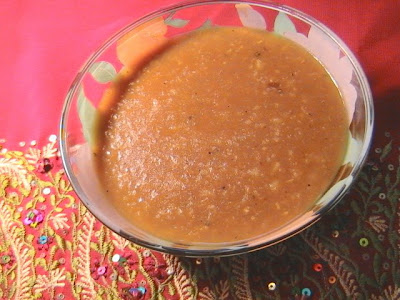
Oats Doddak


I once blogged about how I could never understand people who ate the same stuff for breakfast every day. Rain or shine. That post was about a mango and melon smoothie. That was about 9-10 months ago. Since then oat and fruit smoothies have become a staple for breakfast. Even baby A loves the smoothies for breakfast. But sometimes he craves something savoury. I made this for him one morning and then ate the stuff for lunch. (If you are making this for children, omit the chillies or use a small portion of deseeded chillies.)
 
The use of oats in this doddak is a healthy twist in the tale. Oats keeps hunger pangs away longer thanks to its lower GI and is also full of fibre.
 
Ingredients:

1 cup Oats, roasted and powdered
1 tbsp Semolina
1/4 cup Coconut, scraped
1/4 cup Coriander, chopped
2 Green chillies, chopped
1" piece Ginger, chopped
Salt to taste
Oil for frying

For the tempering:

1 tsp Oil
1/4 tsp Mustard Seeds
1/4 tsp Cumin Seeds
1/4 tsp Asafoetida
7-8 Curry Leaves

Prepare the tempering in a small kadhai and transfer the contents to a mixing bowl. Add the remaining ingredients except the oil and mix well using a little water. (Do not add too much water. The batter should not be watery.)

Pour the dough onto a hot griddle and spread it a little. Pour a few drops of oil on all sides. Make a slit in the centre using the spatula and pour a few drops into this slit.

Turn over and allow the other side to crispen as well. Serve with pitti chitni and toop or with plain butter.

December 3, 2010

Tendlya Bhutti


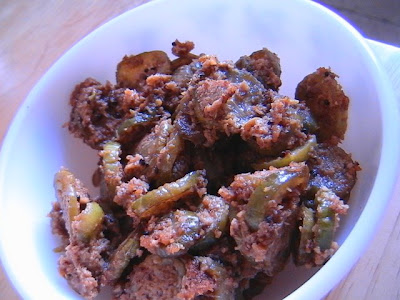
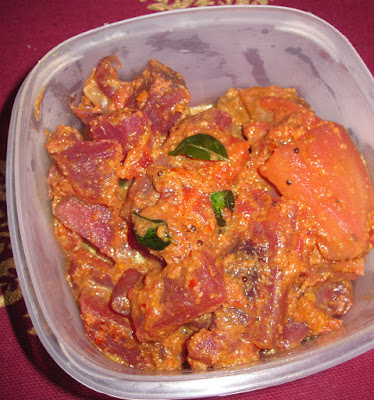
Here is the dish I really wanted to send in to the RCI Udipi and Mangalore (how long ago was that?) event that Sia hosted. I just didn't make it in time. This dish is Mangalorean in every possible way. Amchi in every possible way actually. It has all the ingredients that amchis love: coconut, tamarind, jaggery, bedgi chillies and tendli! Though this is made with a little gravy (not much), I make it a little dry as S likes it that way. (Did you just buy that? Well... as always, I sauntered out of the kitchen with the dish on the stove and returned to almost no gravy!)


1 1/2 cups Ivy Gourd (Tendli/Kundru/Kovakkai/Dondekkai), sliced into discs
Salt and Jaggery to taste

For the masala:
3-4 Red Chillies (preferably Bedgi)
1 tsp Coriander Seeds
1/2 tsp Black Gram Dal (Udad Dal)
1/4 tsp Fenugreek Seeds
4-5 Garlic Cloves
3 tbsp Coconut, scraped
2 tsp Tamarind Paste
1 tsp Oil

For the tempering:
1 tsp Oil
1/4 tsp Mustard Seeds
1/4 tsp Asafoetida

Heat oil in a kadhai. Add the mustard seeds. When the mustard seeds splutter, add the asafoetida. Add the ivy gourd pieces to the oil and fry for a minute. Add the salt and jaggery, mix well and cover and cook for 4-5 minutes.

In the meanwhile, heat the teaspoon of oil for the masala and fry the red chillies, coriander seeds, black gram dal, fenugreek seeds and garlic for a minute or two. Grind this to a paste with the coconut and the tamarind paste.

When the ivy gourd pieces are tender, add the ground masala to the vegetable and mix well. Bring the mixture to a boil and cook until the ivy gourd pieces are covered with the masala and the entire mixture is a little dry.

This is a dish that you can enjoy with chapatis as much as with some rice and dali-saar.

July 6, 2010

Karatya Song


Bitter Gourd! Most people hate it. Some people love it. I am one of those very few people who are indifferent to it. I can't profess undying love for the vegetable. I can never bring myself to say I don't like it. I can't  even relate to either group of people.

I have never stopped looking for recipes that are simple and use bitter gourd. Simple only because S won't touch the vegetable. And I can't do an elaborate routine just for myself, right? (For those of you who're new to this blog, I am about the laziest person you will ever come across.)

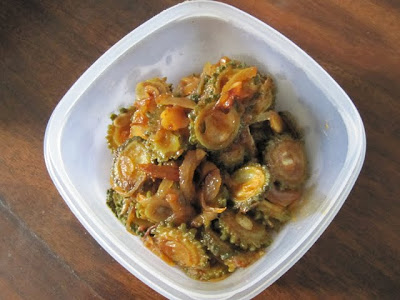
After success with the Batata Song, I decided to try this. S has been a weekend spouse for most part this summer and I conned a wholesale vegetable vendor into selling me just 4 baby bitter gourds. The result of these two seemingly independent incidents is this dish.


4 Baby Bitter Gourds, sliced and steamed
4 Onions, sliced
1 tbsp Tamarind Paste
2 tsp Red Chilli Paste
1 tsp Jaggery, grated
1 tbsp Oil
Salt to taste


Heat the oil in a kadhai. Add the onions and fry for 5-10 minutes, until the onions are evenly browned. Add the tamarind and chilli pastes. After a couple of minutes, add the bitter gourd, jaggery and salt. Add a little water. Cover and cook for a few minutes. Remove the lid and cook for another 2-3 minutes.


This is about the best way to eat bitter gourds. With some hot rotis and a bowl of cold curd, you're all set to have a lovely meal.

May 29, 2010

Batata Song (Saung)


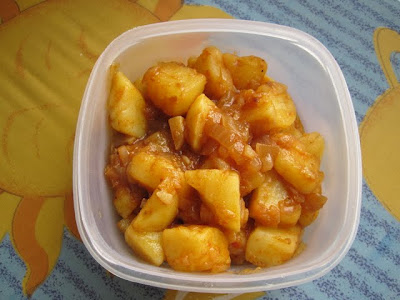
This has to be one of the most popular konkani dishes to have been invented. Amma made it very often when we were growing up and on weekends, we would have a meal of rice, dali-saar and batata song. I can't say it is my favourite dish, but I do love it.


Amma makes a slightly different version which has coconut in it, but I tried this minus the coconut. Amma added coconut to reduce the spice quotient. I have to save my coconut reserves for dishes that absolutely need the sweet white meat. I tried the version with coconut many years ago and I made this verson recently. I always have tamarind paste at hand and I also have a bottle of red chilli paste. So, I didn't even have to grind my "massol". After having made the mushroom version of this dish, I am glad I made the original.


4 Potatoes, cooked, peeled and diced

4 Onions, sliced

1 tbsp Tamarind Paste

2 tsp Red Chilli Paste

1 tbsp Oil

Salt to taste


Heat the oil in a kadhai. Add the onions and fry for 5-10 minutes, until the onions are evenly browned. Add the tamarind and chilli pastes. After a couple of minutes, add the potatoes and salt. Add a little water. Cover and cook for a few minutes. Remove the lid and cook for another 2-3 minutes.

Serve this with some rice and dali-saar. If you grew up with this, there can be no denying the "all is well with the world" feeling that will come over you with every mouthful.

April 18, 2010

Kadgye Sukke


I'm rediscovering traditional cooking. I shied away from traditional cooking for a long time because I wanted to break away from the ordinary. After years of having broken away, it appears as though traditional food is the change I need from my routine.


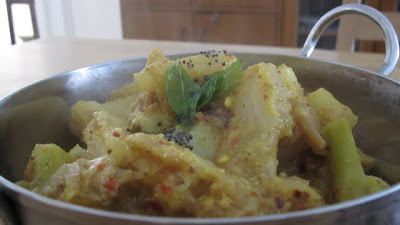
And I'm also rediscovering sukke, as it turns out. I can't seem to have enough of this preparation. While I tried it with different vegetables earlier, I made it this time around with just one vegetable: raw jackfruit. I think this is the best type of sukke I have eaten and that sukke is the best way to eat raw jackfruit. I know I will make this often.


1/4 kg Raw Jackfruit, peeled
1/2 tsp Urad Dal
1/2 tsp Fenugreek Seeds


1/2 tsp Coriander Seeds
1 tsp Oil
1/4 cup Coconut
3-4 Red Chillies
1 tbsp Tamarind Paste
1/4 tsp Turmeric
Salt to taste


For the tempering:


1 tsp Oil
1/4 tsp Mustard Seeds
1/4 tsp Asafoetida
7-8 Curry Leaves


Cut the jackfruit into pieces slightly large pieces. Pressure cook with a little salt for 1-2 whistles.


Heat the oil and fry the fenugreek seeds and the coriander seeds for a minute. Grind this along with the turmeric, tamarind, coconut and red chillies to a somewhat fine paste. Add this paste to the cooked vegetables and add salt to taste. Cook for 4-5 minutes.


Heat the teaspoon of oil for the tempering in a frying ladle. Add the mustard and the asafoetida. When the mustard splutters, add the curry leaves. Add this tempering to the vegetable mixture. Serve hot with rice and dali-saar.

April 13, 2010

Masala Keli


I joined the Great Vega'N Vegetarian project some time ago. I noticed that Cynthia had written a post about steamed plantains for breakfast. It took me back to a time (and place, more importantly) when plantains were easily available. As a child, I don't remember having eaten steamed plantains. I ate them as an adult when someone told me they made for an ideal breakfast.

This dish, however, is one that my mother dished out whenever she could lay her hands on the nendrampazham. A very typically konkani dish that is sweet, spicy and sour, all at once. I asked a colleague to get me half a dozen of these plantains and when he did, I made this.


4 Ripe Plantains (Nendrampazham/Rajali Keli), peeled and diced
3-4 tbsp Coconut
2-3 Green Chillies, finely chopped
1 tbsp Jaggery, grated
2-3 tbsp Coriander Leaves, chopped
2 tsp Tamarind Paste
Salt to taste

For the tempering:

2 tsp Oil
1/4 tsp Mustard Seeds
1/4 tsp Asafoetida
1/2 tsp Turmeric Powder


In a pan, heat the oil and add the mustard seeds. When they splutter, add the asafoetida and the turmeric. Add the green chilli and the diced banana pieces and fry for a couple of minutes. Add the rest of the ingredients and cover and cook for 4-5 minutes. Remove the cover and allow the banana pieces to caramelize a bit.


Enjoy this dish for breakfast or as a tea time snack. I can't seem to ever have enough of this. Let me know what you think.

March 5, 2010

Winter Vegetable Sukke


I make a lot of mixed vegetable dishes, especially in winter. I’ve gone on endlessly about how I like a colourful plate. I found a whole bunch of vegetables that needed to be used up, and quickly. It was time for my weekly vegetable purchasing spree and I had just 1-2 pieces of each vegetable left in the crisper. I made this dish for lunch and used one vegetable of every variety I had on hand. I ended up using seven vegetables. Feel free to use any combination of vegetables for this dish. I’ve found that winter vegetables lend themselves very well to this preparation.


1 Radish, peeled
1 Beetroot, peeled

1 Red Carrot, peeled

1 Purple Carrot, peeled

1 Turnip, peeled
1Potato, peeled and quartered
1Onion, quartered
1/2 tsp Fenugreek Seeds
1/2 tsp Coriander Seeds

1/2 tsp Urad Dal
1 tsp Oil
1/4 cup Coconut
3-4 Red Chillies
1 tbsp Tamarind Paste
1/4 tsp Turmeric
Salt to taste

For the tempering:
1 tsp Oil
1/4 tsp Mustard Seeds
1/4 tsp Asafoetida
7-8 Curry Leaves

Cut the radish, carrots, turnip and beetroot into 2" long pieces. Pressure cook all the vegetables with a little salt for 1-2 whistles.

Heat the oil and fry the fenugreek seeds, urad dal and the coriander seeds for a minute. Grind this along with the turmeric, tamarind, coconut and red chillies to a somewhat fine paste. Add this paste to the cooked vegetables and add salt to taste. Cook for 4-5 minutes.

Heat the teaspoon of oil for the tempering in a frying ladle. Add the mustard and the asafoetida. When the mustard splutters, add the curry leaves. Add this tempering to the vegetable mixture. Serve hot with rice and
dali-saar or with chapatis.

December 27, 2009

Radish-Broccoli-Onion-Potato Sukke


Elaborate lunches. They get pushed to weekends. When the weekend comes, they get pushed back into the next week. This kept happening for quite a while before I realized that we were eating one pot meals all the time. One weekend, I decided to fix this issue and made a konkani meal. Sukke, dali-saar and rice. Not elaborate by any standards, but when all your other meals are pulaos or mixed rice dishes or roti and sabzi at best, this meal, simple as it might be, comes as a much needed whiff of fresh air.


Sukke is a dish that was a staple at Amma's place, more as a side for chapatis than with rice and dali-saar. I added whatever vegetables I wanted to use up and I was rather happy with the result. I tend to use broccoli florets a lot and the stalks always seemed to only get used in soup. Now, I am bursting with ideas to use broccoli stalks in many ways.


1 Radish, peeled

1/2 cup Broccoli stalks, peeled

2 Potatoes, peeled and quartered

2 Onions, quartered

1/2 tsp Fenugreek Seeds

1/2 tsp Coriander Seeds

1 tsp Oil

1/4 cup Coconut

3-4 Red Chillies

1 tbsp Tamarind Paste

1/4 tsp Turmeric

2 tsp Jaggery (optional)

Salt to taste


For the tempering:

1 tsp Oil

1/4 tsp Mustard Seeds

1/4 tsp Asafoetida

7-8 Curry Leaves


Cut the radish and the broccoli stalks into 2" long pieces. Pressure cook the radish, broccoli stalks, onions and potatoes with a little salt for 1-2 whistles.


Heat the oil and fry the fenugreek seeds and the coriander seeds for a minute. Grind this along with the turmeric, tamarind, coconut and red chillies to a somewhat fine paste. Add this paste to the cooked vegetables and add salt to taste. Add the jaggery, if using. Cook for 4-5 minutes.


Heat the teaspoon of oil for the tempering in a frying ladle. Add the mustard and the asafoetida. When the mustard splutters, add the curry leaves. Add this tempering to the vegetable mixture. Serve hot with rice and dali-saar.

August 30, 2009

Baked Somashe


Festivals are always about food, aren't they? When I know a certain festival is coming up, I plan what I'm going to make. This year, Gowri Tritiya and Ganesh Chaturthi came on the same day. (I doubt I will ever understand the Indian calendar system!) So, while we performed both the pujas in the morning, I decided to make Tritiya food for lunch and Chaturthi food for dinner. (Including dali saar and Patrodo.)


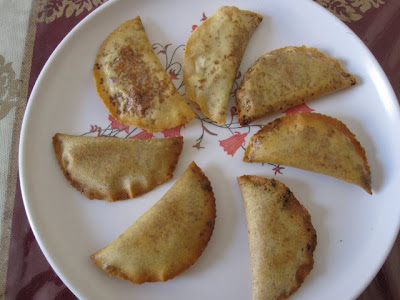
I decided to take it easy and brought the chaklis from a store. I then decided to take it even easier and use readymade wonton wrappers for the somashe. And given how sultry it was, I chose to bake them. They taste almost nothing like the hand rolled, deep fried versions. In fact, these are more like cookies with their caramelized sugary flavour and that crunch. I would definitely make these again.


20-22 Wonton wrappers


For the filling:

1 1/8 cup Sugar

1 cup Water

3/4 cup Coconut, scraped

1/2 cup Cream of Wheat (Rava/Sooji)

1/4 cup Cashews

1 tsp Cardamom powder

2 tbsp Sesame Seeds


Roast the coconut, cream of wheat and sesame seeds individually and keep aside.

Make a sugar syrup of 1 thread consistency with the sugar and water. Add the coconut, sesame and cream of wheat along with the cashews and cardamom powder. Mix well and allow to cool.

Place a wonton wrapper inside a somashi press. Place some filling on one half and dab a little water along the edges. Cover with the other half and close the press and hold it down. Remove the somashi from the press, remove the excess wrapper and seal the edges again with your fingers (just to be doubly sure!). Place on a damp towel and cover. Repeat with the other wrappers.

Preheat the oven to 200C/400F.

Place these on a greased baking tray and bake for 7 minutes. Turn each somashi over and bake for another 7 minutes. Your almost "no-sweat" somashe are ready! This post is late for Ganesh Chaturthi, but by the time you get to read this, I would be attending the Visarjan puja at my uncle's place in Matunga. I hope you all had a good Teyi/Chavati.

June 9, 2009

Sheera


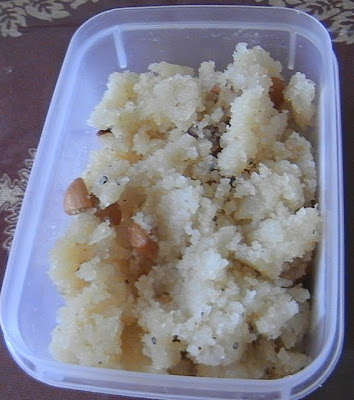
I have very few Indian sweets on this blog. There are a few payasams and a couple of kulfis, but that's about it. I guess it says a lot about my taste. I must admit, I am not the biggest mithai fan on this planet. When I do crave an Indian sweet, it is far simpler to get a small box from the mithai shop than to try making it at home. In fact, it is easier to go to the sweet shop and buy just one piece and eat it. (And I have done that. It satisfies the craving then and there. Plus you are not "forced" to give in to temptation later on.)


This is by far the simplest sweet dish to make. I made it one morning as it was my father-in-law's birthday. S was very surprised to see a sweet dish at the breakfast table, sitting pretty next to the upma. The quintessential Bangalore Darshini combination that makes Chow-chow Bhaat!


1 cup Cream of Wheat(Rava/Sooji/Semolina)

1 cup Sugar

1 cup Milk

1 Ripe Banana, chopped

1 cup Water

2-4 tbsp Ghee (Clarified Butter)

1 tbsp Cashews

1 tbsp Raisins

¼ tsp Cardamom Powder


Roast the semolina in 1 tbsp of ghee over a low flame till it lets out a lovely aroma and turns light brown.


In a separate vessel, heat the milk, banana, sugar and water. When the mixture comes to a boil, add the cardamom powder. Add the roasted semolina and cover and cook for 5-10 minutes.


In a frying ladle, heat 1 tbsp of ghee and fry the cashews until brown. Add the raisins and take the ladle of the heat. Add this to the cooked semolina mixture. Add the remaining ghee to the sheera and mix well. Enjoy this fresh. And if you're lucky to have leftovers, heat some in a kadhai the next day. Allow some parts to get crisp. Enjoy the same dish in a different avatar.

June 3, 2009

Wheat and Green Gram Doddak


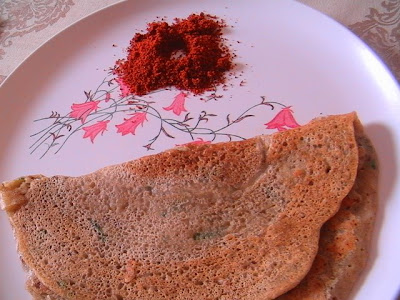
Fusion foods. I somehow always thought of them as very exotic. Like Malabar Parathas with Thai Green Curry that I once had at Cosmo Village in Bangalore. I didn't think of a fusion of two or more Indian cuisines. I made this doddak some time ago. It is only now, when I sat down to blog about it, that I figured out the fusion element in my recipe. The cross between the Andhra Pesarattu and the Konkani Gava Pittye Doddak is what became our tasty breakfast dish.

1/2 cup Wheat Flour
1/2 cup Moong Flour
2 tbsp Cream of Wheat (Rava/Sooji)
2 tbsp Coconut, scraped
1 tsp Green Chilli Paste
1/4 tsp Cumin Seeds
1/4 cup Coriander, chopped
Salt to taste
Oil for frying


For the tempering:
1 tsp Oil
1/4 tsp Mustard Seeds
1/4 tsp Asafoetida
7-8 Curry Leaves


Prepare the tempering in a small kadhai and transfer the contents to a mixing bowl. Add the remaining ingredients except the oil and mix well using a little water. (The batter should not be too watery, just a little thicker than
dosa batter.)


Spread the dough onto a hot griddle and pour a few drops of oil on all sides. Make a slit in the centre using the spatula and pour a few drops into this slit. (This helps the oil reach the centre
and aids in crispening that portion.)Turn over and allow the other side to crispen as well.)

Serve hot with a chutney, podi or sambar on the side. The moong powder makes this a meal by itself. So it is perfect for those weeknight dinners as well.

June 1, 2009

Andurli


I'm back with an authentic konkani recipe after ages. It is the mango season here. I must admit that I haven't had my fill yet. I can't help it if peaches, apricots, cherries and litchis made their way into the market almost a month before their time. We did buy and eat some Banganpalli mangoes in April and May. I found these smaller mangoes called Gola. They instantly reminded me of the small mangoes called Gontambe which are used in the famous amchi dish called Andurli. Although the Gola mangoes are much bigger, I made the dish last week and found that this variety of mangoes is very tasty.


6 small Ripe Mangoes

1/4 cup Jaggery

1/2 tsp Pepper Powder

1 tsp Rice Flour

Salt to taste


For the tempering:

1 tsp Oil

1/4 tsp Mustard Seeds

1/4 tsp Asafoetida

7-8 Curry Leaves

3-4 Red Chillies


Peel the mangoes and keep the peel in a bowl with about 1 cup of water. Squeeze the juice from the peels and discard the peels.


Place the mangoes and the water in a pan. Add the jaggery, salt and pepper and bring the mixture to a boil. Mix the rice flour in a little water and add it to the mixture. Simmer for 10-12 minutes until the mangoes are cooked.


In a frying ladle, heat the oil and add the mustard seeds and the asafoetida. When the mustard splutters, add the curry leaves and the red chillies. Add this to the mangoes.


Serve as a side dish with rice, dali-saar, and some upkari. This particular combination of spicy and sweet is an acquired taste. Most konkani folks are initiated into this spicy-sour-sweet combination early on in life. If you don't particularly fancy a side dish with mixed tastes, have it on its own.

April 27, 2009

Tori Saar Upkari


There are cookbooks and there are cookbooks. And then there are mothers who are treasure troves of recipes. This time around when my parents visited us, I made it a point to specifically ask for some dishes and made note of the recipes. I found that Amma's style of amchi cooking isn't exactly the way Rasachandrika has it. There are minor tweaks here and there. This saar-upkari is a great example.

I've made two kinds of saar-upkari before. This one feels like a saar-upkari with a twist in the tale.


1 cup Pigeon Peas
1 tbsp Coriander Seeds
4 Red Chillies
1 tbsp Tamarind Paste
2 tbsp Coconut
1 tbsp Jaggery
Salt to taste


For the seasoning:
1 tsp Oil
1/4 tsp Mustard Seeds
1/4 tsp Asafoetida
7-8 Curry Leaves


For the Upkari:

Cooked Pigeon Peas(from recipe above)
1 tsp Oil
1/4 tsp Mustard Seeds
4-5 Curry Leaves
Salt to taste


Pressure cook the pigeon peas with 4-5 cups of water. Drain the liquid into a vessel. Keep the pigeon peas for the upkari.

Grind together about 2 tbsp of cooked pigeon peas with the coconut, coriander seeds, tamarind paste, and red chillies. Add some of this paste to the liquid in the vessel. Add the salt and bring to a boil. In a frying ladle, heat the oil and add the mustard seeds and the asafoetida. When the mustard splutters, add the curry leaves. Add this to the saar.

Upkari


In a kadhai, heat the oil. Add the mustard, red chillies and the curry leaves. When the mustard splutters, add the cooked pigeon peas, salt and jaggery and the ground paste. Cover and cook for about 5 minutes.

This is my idea of a super sunday!

April 3, 2009

Moong Kosumbari (Yugadi /Rama Navami Pachadi)


This is a very simple dish that is made on Yugadi as well as Rama Navami. It has a nice tang from green mangoes which is probably the reason I enjoy this the most. (Please note that this is not the Ugadi Pachadi that is made in Andhra Pradesh.)


I made this in bulk last week to take to a slightly belated Yugadi celebration at the New Delhi Konkani Sabha on Sunday. I made this for 70 people. I expected to bring back a lot of it. I even joked to S that we could take a box each to work the next day. As it turned out, we did have lots left when people began leaving. Just when I started to close my boxes, a lady walked up to me and said, "If you don't mind, I'd like to take some of this home." I was thrilled. I emptied all the contents of one box into her container. She eyed the next box. I quickly emptied that as well. She said, "I came back quickly because I definitely wasn't going back without the pachadi." I said, "Thanks, I'm honoured." She looked at me and her expression was one of complete surprise. I probably didn't look like one of those people who could (and would) have anything to do cooking. But hey, I was thrilled.

Such encounters always take me back to this topic. But it could just be me. People who know me also know how lazy I can be. Considering I commute from Gurgaon to NOIDA and back everyday, they probably expect that I would not lift a finger. In a way, I'd like for people to think that of me. (The lower the expectations, the happier they'll be with anything I do.)

Coming to my "nearly award winning" recipe:

2-3 tbsp Cucumber, grated or finely chopped
1/2 cup Moong Dal, washed and soaked for an hour
2 tbsp scraped Coconut
1 tsp Green Chilli-Ginger paste
1 small Raw Mango, grated (or juice of 1 Lime)
Salt to Taste
Coriander leaves for garnish


For the tempering:
1 tsp Oil
1/4 tsp Mustard Seeds
1/4 tsp Asafoetida
7-8 Curry Leaves


Grind the coconut along with the chilli-ginger paste and make a rough chutney like paste.


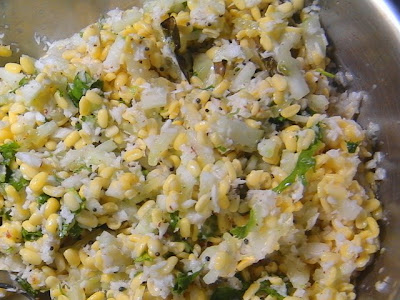
Place the soaked moong dal in a large bowl. Add the ground paste, cucumber, raw mango, salt and mix well. In a small kadhai or frying ladle, heat the oil, add the mustard seeds and asafoetida, and when the mustard splutters, add the curry leaves. Add this to the cucumber mixture.

Your pachadi is ready. Go ahead and make this on Rama Navami and get ready to get appreciation by the truck load. This is the last of the three part series on Rama Navami. I think I have finally gotten around to at least cooking and posting about things festive.

March 27, 2009

Mugga Dali Kheeri for Yugadi


Most of my posts are on auto publish these days. The posts were written over many weekends when I had little else to do. While I tend to post every alternate day (so that I won't suddenly find that my pipeline has gone dry), just for today, I decided to play around with the schedule. I usually do that when there's something special I want to talk about. A birthday or a festival usually makes it to the list.

This blog hasn't seen too many "festival" specials. There are many reasons for that. The biggest reason is probably the time lag between the making and the posting. And honestly, I don't even "make" that much. Is it a sign of the times, is it a sign of my laziness, is it just me asking the question why? Each time, I'd probably pick "lazy". Then again, I have a job that keeps me at work for more than 9 hours a day and the commute usually takes up another 4. So, if I even manage to "make" anything festival related on the actual date of the festival, I would be too tired to talk about it here. After a few days or weeks, it seems so out of place. Maybe I should talk about them the following year. Like I remember taking pictures of our Pongal feast last year. I managed to sneak one of those pictures into this year's post.

While I am not in favour of celebrating every festival around the weekend closest to it (I mean, what is the point?), I have to resort to doing just that, at times. Often, I make one dish that is part of the meal for that festival and leave it at that. Something is better than nothing, right? As this new year begins, I am caught between the past, the present and the future. Will the traditions of my family carry on? Growing up, I had to contend with Konkani festivals and Tamil festivals. Now I have added a third dimension, Telugu festivals. I'm glad that many of them coincide. It is the new year for us (on my mother's side of the family) as well as for S' side of the family. (And for all of you out there who call this the Telugu New Year, please, please, I beg you to stop doing that. It is the New Year for anyone who follows the lunar calendar in India.)


My MIL said that the sweet dish that they make for today is Bobatlu (Punpolo in Konkani, Poli in Tamil, Puranpoli in Marathi). Among other things, Saraswats make this kheer with green gram dal. It is anyone's guess which I'd pick to make today. Much as I'd love to eat the Bobatlu, I'm not even going to think about making it on my own today. (I have made it a couple of times in the past. Feels like a different life though!) Today it has to be Mugga (Moong) Dali (Dal) Kheeri (Kheer). We also make panak (I shall blog about it later as we make it for a different festival too - same as the Tamil Panakam) and usli.


Here's the recipe:


1 cup Green Gram Dal (Moong Dal)
1/2 cup Coconut Milk
2 tsp Ghee
3/4 cup Jaggery
1/4 tsp Cardamom Powder


Heat the ghee in a pressure pan. Add the green gram dal and fry for a few minutes. Add about 3 cups of water and and pressure cook for 3 whistles. Add the jaggery and cook for 5-7 minutes. Blend in the coconut milk and the cardamom powder.


There you go. There couldn't have been a simpler way to make kheer. And there isn't a sweeter way to usher in the New Year. I don't have access to Neem leaves and flowers and as a result, I am not making the Telugu Ugadi Pachadi or the Konkani equivalent (which is very similar to this and has raw mango as well) . For today, I will just have to make do with this bowl of kheer. May you and yours enjoy a lovely year.

February 15, 2009

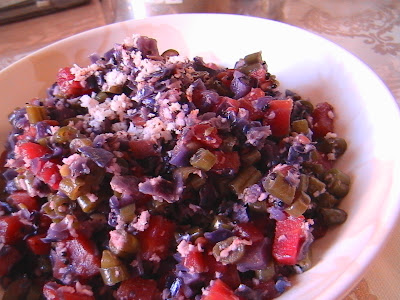
Rainbow on my Plate (Mixed Vegetable Upkari)


Traditions. Sometimes broken, sometimes followed. I don't know which better applies to my cooking. I think I fall somewhere in the middle. Neither here, nor there. There are times when I break every tradition I know and cook something that, quite frankly, doesn't even have a name. And there are times when I follow my mother's (or grandmothers') recipes to a T.


This recipe is one that follows the middle path. One foot in the known, one in the unknown. The desire to make my lunch as colourful as possible is always overwhelming. The desire to experiment cannot be ignored. The desire to use new vegetables in my cooking eggs me on.


I had decided to cook a traditional meal for my parents and S. Yet, I felt the need to show off. So, I made some brinjal menthi kuzhambu (Appa's favourite), paruppu thogayal/thuvayal and this mixed vegetable upkari. The colours of this simple dish were too beautiful to be ignored.


100g Beans, strung and cut into 1/2 inch pieces

100g Carrots, diced

100g Purple Cabbage, chopped
1 tsp Oil
1/4 tsp Urad Dal
1/4 tsp Mustard Seeds
2 Red Chillies
1/4 tsp Asafoetida (optional)
1 tbsp Coconut, scraped
7-8 Curry Leaves
Salt to taste


Heat oil in a pressure pan. Add the urad dal, mustard seeds and asafoetida(if using). When the mustard splutters, add the curry leaves and the red chillies. Fry for a minute. Add the chopped beans, carrots and cabbage. Add some salt along with a little water. Cover and cook for one whistle.


When done, open and cook without the lid to let the excess water evaporate. Add the coconut and mix well.

February 7, 2009

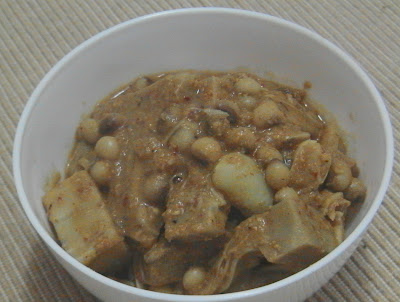
Kadgi Tori Ghasshi


Of late, Amma doesn't seem to cook that many amchi dishes. I figured this was because she only has to cook for two people. Appa has very limited tolerance for spices. What's amchi cooking without the fiery heat of bedgi chillies. Moreover, Appa seems to like typical Iyengar food and stuff like Italian and Chinese. It is not that he won't eat the other stuff, these would be his preference.


So I am not partial to either of them. One morning, I decided to cook some amchi food. Of the four members in the house at this point, three love this cuisine. So, whyever not? I had asked Amma to bring some more Pigeon Peas (Tori) from Bombay. When I get fresh stock of things I don't get in Delhi/Gurgaon, I am tempted to use them right away.


250g Raw Jackfruit, cut and cooked

1/2 cup Pigeon Peas (Tori/Tuvar), soaked overnight and cooked

2 tbsp Scraped Coconut

3-4 Red Chillies

1 1/2 tsp Coriander Seeds

1 tbsp Tamarind Paste (Add more or less to taste)

Salt to taste

1 tsp Oil


For the tempering:

1 tsp Oil

2-3 Garlic Pods, crushed


For a no onion/garlic version, use this tempering:

1 tsp Oil

1/4 tsp Mustard Seeds

1/4 tsp Asafoetida

7-8 Curry Leaves


Heat the oil in a small kadhai and fry the chillies and coriander seeds. Grind this together with the tamarind paste and coconut. Add a handful of cooked pigeon peas to this and grind to a paste.


In a vessel, combine the cooked pigeon peas, jackfruit, the paste and salt. Add some water to this and bring to a boil.


In a frying ladle, heat the oil, add the garlic pods. If using the other tempering, heat the oil and add the
mustard seeds and asafoetida, and when the mustard splutters, add the curry leaves. Add the tempering to the ghasshi and serve hot.


P.S.: Amchi is an abbreviation for "amchigele" which is how konkani people refer to the language (and other people who speak the language).

January 29, 2009

Phaggila Phodiyo (With a Sulekha Update)


Phaggil and Parval – two vegetables that we didn’t see on a regular basis. Maybe that is why I like them. I get a lot of Parval in Delhi and Gurgaon, and I have cooked it once. S doesn’t really like it. He also doesn’t like Bitter Gourd. So, he didn’t take too kindly to Phaggil either. It looks like bitter gourd. It is even called Jungli Karela in Hyderabad. I found this vegetable in the market many months ago. I brought some home, sliced them and stored them in the freezer. Someday, I thought. Someday.


We had invited two couples home for lunch a couple of weekends ago. I decided to make some vangi bhat, vendakka pachadi, rice, sambar and cabbage karumadhu. At the very last minute, I decided to make use of the contents of my Ziploc bag. So, when I started the preparations, I brought the bag out and let the contents thaw. I figured that even if S doesn’t are much for the vegetable, the others might enjoy it. My hopes were dashed when I served these on the table and one of the guests asked, “Yeh karela hai kya?”(Is this bitter gourd?) and S promptly replied, “Haan.”(Yes) I quickly said, “Nahin, yeh karela nahin hai. Ise jungli karela kehte hain.” (No, this is not bitter gourd. This is called Wild Bitter Gourd.) And then S went on to say something like, “It’s the same thing.” That did it. A couple of the guests didn’t even want to touch it. But hey, I don’t get phaggil everyday and I don’t deep fry everyday. So, if my guests didn’t eat it, it is a good thing (for me, that is). A couple of them did try it and maybe they liked it. Even S said, “Hey, this is not bitter at all.”


1 cup Phaggil, sliced

2 tsp Chilli Powder
1 tsp Turmeric Powder
1/4 tsp Asafoetida
1 tbsp Rice Flour
Oil for frying
Salt to taste


Place the phaggil slices on a plate and apply the salt, chilli powder, turmeric powder and asafoetida. Keep aside for 10 minutes.


Heat the oil in a kadhai.


Sprinkle the rice flour over the phaggil pieces and make a coating of sorts. Deep fry the pieces in the oil and drain on a paper towel.


Serve with some rice,

dali-saar and any masla randeyi and make it a complete amchi meal.


Here's an update on the Sulekha issue:


I got an email from the lady in member relations:


Dear Arundhati Raghavan,

Thanks for the mails.

I would like to inform that based on your report & our investigations; that your blogs were plagiarized by our member “AndhraMirchi” I have deleted all blogs and the blogger completely from Sulekha’s records.

In regards to “saraamulu”. I’m sorry I can’t take action immediately because most of my technical team are away for their vacation’s; Monday being a holiday for the republic day. Please give me a week’s time to check, assess and delete. Meanwhile I request you to please send me a few links that have been plagiarized by saraamulu. I’m sorry for the inconvenience caused. Have a nice weekend.

Warm regards,

Neha


I have sent them this email and shall wait patiently for the week to end:


Dear Neha,

I hope you had a good weekend. I also hope that your technical staff is back from vacation.

Here's an update from my side.

I still find my photograph on this page: http://food.sulekha.com/cuisine/karnataka/capsicum-phodiyo/recipes.htm

The content on this page: http://food.sulekha.com/cuisine/karnataka/cauliflower-phodiyo.htm is still what it was earlier. Saraamulu still seems to be a member.

The photograph on this page: http://food.sulekha.com/cuisine/karnataka/cauliflower-phodiyo.htm is mine.

The photograph on this page: http://food.sulekha.com/cuisine/karnataka/narlya-kheeri/photos.htm is also mine.

This photo: http://food.sulekha.com/cuisine/karnataka/madgane/photos.htm is also mine. Please let me know when all my content will be removed.

Thanks,

Arundhati

January 25, 2009

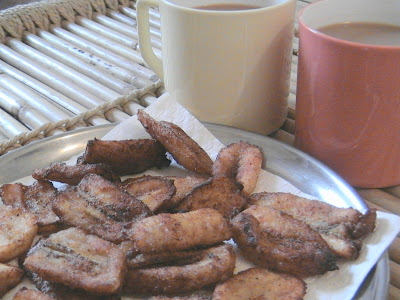
Ripe Plantain Fritters


Tea-time. I've really forgotten about that concept. At my parents' place, we had coffee in the morning and tea in the afternoon. I had a glass of milk both times. There was always a stock of biscuits at home, and tea time didn't mean snacks of any sort. At almost all my relatives' places, tea-time was a ritual. So, while I can't say the concept is alien to me, I definitely don't relate it to it all the time.


We happened to be home one afternoon and I decided to make tea. I also found a couple of plantains in the fridge that didn't seem that raw to me anymore. I made these fritters that are usually made with Rajali Bananas (Nendrampazham). It didn't taste the same, but I we relished them nonetheless. And I was glad I didn't have to throw the plantains out.


2 Ripe Plantains, peeled

1 tsp Chilli Powder

1 tbsp Rice Flour

Salt to taste

Oil for frying


Cut the plantains in half and slice lengthwise. Add the salt and chilli powder and keep aside for 4-5 minutes.


Heat the oil in a kadhai. Add the rice flour to the plantains and mix well. Drop the plantain slices into the hot oil and fry until golden brown. Drain on a paper towel.


Enjoy these with a hot cup of tea. Just make sure the tea is ready when these fritters are. If you make these first and then make the tea, you may not have any left for you by the time you're done making the tea.