Google
 
Showing posts with label Pachadi/Raita. Show all posts

November 23, 2008

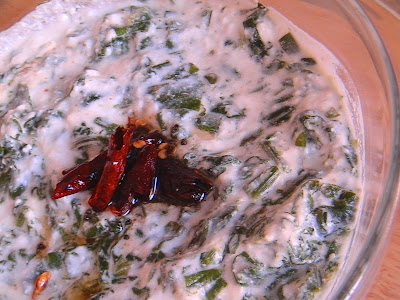
Palak Raita


I have no idea how I learnt this dish. Or where. Or who from. But I have been making this regularly ever since I figured that spinach could be used this way. I made this yesterday and S said I hadn't made this since we got married. I will be making this more often through this winter when spinach is available in plenty.


1 bunch Spinach, cleaned

1 cup Curd, beaten lightly

1/4 tsp Ginger paste (optional)

1/4 tsp Cumin Powder

Salt to taste


For the tempering:

1 tsp Oil

1/4 tsp Mustard Seeds

1/4 tsp Asafoetida

2 Red Chillies, broken


Place the cleaned spinach in a microwave safe bowl and cook for 4-5 minutes. Cool and chop roughly.


Add this to the beaten curd along with the salt, ginger (if using) and cumin powder.


In a frying ladle, heat the oil. Add the mustard seeds and asafoetida. When the mustard splutters, add the red chillies. After a minute turn off the flame and pour the tempering over the spinach-curd mixture.


With a little over a week of the marathon left, check out these blogs: Siri, Srivalli, Ranji, PJ, Curry Leaf, Medha, Priya, Bhawna, Raaji, Ruchii, Anu, Kamala, Roopa, Divya Kudua, Rekha, Divya M, Lakshmi, Lakshmi Venkatesh , Sripriya, Viji, Kamalika, Pavani, Karuna and Roochi.

October 19, 2008

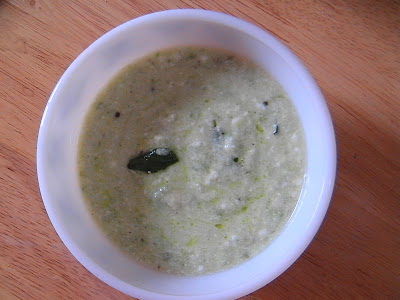
Mantav Ghashala Bajji


A complicated name for an oh-so-simple dish. Mantav Ghashale is the Konkani name for what is known as Tori in Hindi. The Spencer's super market here calls it Smooth Gourd. I think that's because it is a smooth version of the Ridge Gourd. While I have no love for either vegetable, I have cooked both very often. Summers in Delhi/NCR mean that you eat the same vegetables over and over again. During one vegetable buying trip, I'd gone through everything and picked up nothing. S came over and said, "Are the vegetables so bad?" And I said, "No, but I just made all of these last week." As I said it, I realized what was happening. I forced myself to pick up the same vegetables. I figured that if I needed a change, I simply had to cook the same vegetables differently.


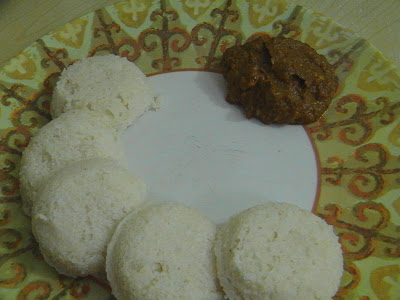
For instance, I made a thuvayal with Tori with go with idlis. I followed the recipe for Peerkangai Thuvayal. I decided that thuvayals are great sides with idlis and dosas as they have more than a decent helping of vegetables. (And don't ask for my recipe for idlis. I really don't have one and, much to Amma's disgust, continue to use MTR Rice Idli mixes.)


I remember that Amma made this "bajji" a few times. This bajji is not to be confused with the one that belongs in the bonda family. It is a simple side dish, quite like a tayir pachadi. So when you put Mantav Ghashale and Bajji together, you get this dish! The day I made it, it was a welcome change from the normal Tori sabji.


4 Smooth Gourds

2 Green Chillies

2-3 tbsp Coconut, scraped

1 cup Curd, beaten


For the tempering:
1 tsp Oil
1/4 tsp Mustard Seeds
7-8 Curry Leaves

1/4 tsp Asafoetida


Roughly scrape the skin of the gourds. Do not peel. Chop them into 1 inch cubes and place the in a microwave safe bowl. Cook on high for 3-4 minutes. Cool.


Grind together the cooked gourd pieces with the coconut and chillies. Mix together with the beaten curd.


In a frying ladle, heat the oil, add the mustard seeds, and when they splutter, add the asafoetida and curry leaves. Add this to the vegetable-curd mixture.


Your side dish is ready!

June 28, 2008

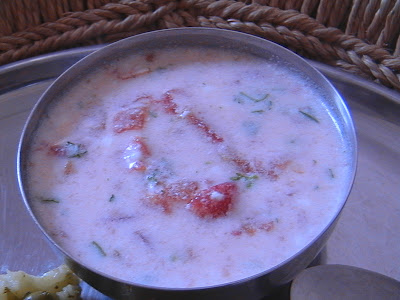
Tomato Pachadi

I eat a lot of curd. I desisted curd rice when I was a child. I’d always ask Amma why I had to eat curd rice when I’d already eaten rice with sambar and rasam. She tried to explain to me that is was good for me. I don’t think I ever bought her explanations. I do eat curd rice every once in a while, but I end any meal with curd. So, even if I have a box of pasta for lunch, I carry along a box of curd.


When I am full of enthusiasm or energy or both, I make raita or pachadi with the curd. This tomato pachadi is something that I make very often. I just never bothered to take a picture of it or blog about it. Until today, that is.


3 Tomatoes, blanched, peeled and chopped
1 cup Curd
1 tsp Chilli Paste
1 tsp Ginger Paste
2 tbsp Coriander, chopped
Salt to taste


For the Tempering:

1 tsp Cooking Oil

1 tsp Mustard Seeds

½ tsp Asafoetida (Hing)

7-8 Curry Leaves


Whip the curd and add a little water. Add the ginger and chilli pastes and salt and mix well. Add the tomato pieces and the coriander.


In a frying ladle, heat the oil. Add the mustard seeds and asafoetida. When the mustard splutters, add the curry leaves. Pour this over the tomato curd mixture.


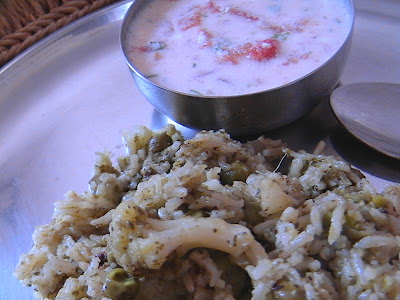
We had this with some cauliflower peas pulao on a very lazy Sunday afternoon.
This is off to Siri for her Frozen Yogurt event.

August 25, 2007

Dahi Nadia


When Swapna announced the RCI: Oriya Cuisine event, I thought to myself, "Even though I've had Oriya friends and colleagues, I have never learnt much about the cuisine of the state. I read Bijoylaxmi Hota's interview in The Hindu when she released her book Healthy Oriya Cuisine along with her daughter, Kabita Pattanaik.


Soon after reading the article which talks about acidic and alkaline foods, I met a lady who had spent all her life in Orissa, though she was originally from Bengal. I asked her about Oriya cuisine and I was rather shocked when she said, "There's nothing great about Oriya Food." I left it at that. If I didn't like something I'd say that I didn't like it. I think each cuisine has its own flavours, tastes and hues.

Anyway, my research told me that the cuisine has so much in common with other state cuisines. I found recipes of things like were similar to the aloo bonda (batata vada) and one sweet dish that was the adirasam of Tamilnadu. I found this recipe on Oriya Kitchen which has an uncanny resemblance to the Tayir Pachadi of Tamilnadu.


Ingredients:

1/2 Fresh Coconut(grated)

2 green chillies

1 cup Curd

small piece of Ginger

4-5 Curry leaves

1tbsp Sugar

Salt to taste

Punch phutan

1tbsp oil

Process:


Beat the curd properly. Add the sugar, salt and coconut to the curdand keep aside in a bowl. Cut green chillies and ginger into small pieces.


Heat oil in a frying pan. Add punch phutan and allow it to splutter. Add curry leaves, ginger and green chillies and fry them little bit. Add the seasoning to the curd mixture.


This is being rushed to Swapna as today is the last date for the RCI: Orissa event. Happy hosting Swapna.

August 8, 2007

Kabuli Pulao and Raita


Chhole Chawal and Rajma Chawal are staples across Delhi. Some of the best places where I’ve eaten these would be Nehru Place and Connaught Place. I’ve probably made Rajma once in my life. And after an overnight soak and 15 whistles in the cooker, my rajma was hard as ever. Since I was only cooking for myself back then, I endured it. Chhole, however, is another saga altogether. I have made it many times and in several different ways. Amma even has a zero oil recipe which I shall post soon.

I soaked chick peas to make chhole but ended up making yet another rice dish. It is almost like chhole chawal, except that the masala is slightly different and the rice is cooked along with the chhole.

200g Chick peas, soaked overnight
2 Onions, sliced
2 tbsp Tomato Puree
1 tbsp Oil
½ tsp Cumin Seeds
½ tsp Asafoetida
1 tsp Chilli paste
½ tsp Ginger-Garlic paste
1 tsp Green Chilli paste
½ tsp Turmeric Powder
1 tsp Pav Bhaji Masala
Salt to taste
1 cup Basmati rice

Heat the oil in a pressure pan. Add the cumin seeds and asafoetida. When the cumin crackles, add the onions and fry for 2 minutes. Add the chilli paste and the ginger garlic paste and fry for another minute. Add the chilli and turmeric powders along with the pav bhaji masala and fry for a minute. Add the tomato puree and salt. When the mixture bubbles, add the chickpeas and rice. Stir well. Add 2 cups of hot water and cook for 2 whistles.

When done, garnish with coriander leaves and enjoy it with some raita.

This raita is ready within minutes.


Chop an onion and a tomato finely. Add a finely chopped green chilli to a bowl of curd. Add salt and beat well. Add the onion and tomato pieces. Garnish with coriander.

If you have soaked chick peas on hand, this meal is ready in 25 minutes flat. And it has a good mix of carbohydrates, proteins, fat and a share of vegetables too. So, this goes to Mallugirl’s Express Cooking challenge.


Rice being the main ingredient here, I am also sending this entry to Jihva for ingredients started by Indira of Mahanandi and hosted by Sharmi of Neivedyam.

July 14, 2007

Vellarikkai Pachadi (Cucumber in Curd)


All of us are always trying to make our meals more interesting. S thinks I am now doing all this because of my food blogging addiction. But by his own admission, I'd not repeated a dish in the first 3 months of our marriage. Not one repetition for any meal. And we didn't even have a gas connection in those days. I had a 45 year old electric stove with no heat regulator that has been passed down from Amma to me. I cooked on that for 3 months. We got our gas connection either in late December or in January of this year. (Yup! We've only been married 9 months.)


So, all I'm really doing differently now is cooking on a 4 burner stove and religiously taking pictures of whatever I make. Here's a dish that doesn't require much cooking. It serves as a great accompaniment to sambar rice, bisi bele huli anna, vangi bhat,etc.
1 Cucumber, peeled and cubed
1 cup Curd
1/2 tsp Chilli paste
1/2 tsp Ginger Paste
For the tempering:
1 tsp Oil
1/4 tsp Mustard Seeds
1/4 tsp Asafoetida
7-8 Curry Leaves
Salt to taste
Whip the curd and add a little water. Add the ginger and chilli pastes and salt and mix well. Add the cucumber pieces.
In a small kadhai, heat the oil. Add the mustard seeds and asafoetida. When the mustard splutters, add the curry leaves. Pour this over the cucumber curd mixture. Chill for an hour before serving. Garnish with coriander leaves if you wish.

June 6, 2007

Vendakka Pachadi (Lady's Finger in Curd)


I hadn't used vendakkai for anything other than sambar. I just never knew how to cook it and make a curry. And all my friends would tell me that it is the easiest to make. I did finally attempt to make it sometime back and have gotten the hang of it. FINALLY!


As a child, I didn't eat lady's finger. I mean, I would eat it, but not EAT it. I didn't enjoy it. Why? Because my brother loved it. How can I relish what he loves? We are Boy and Girl, right? So we can't like the same things. And "Eww... excuse me. How can anything he likes be nice?" But then years later, when I completed class 12, I suddenly found myself spending a lot of time with my kindergarten and elementary school friend, Priya. She LOVED lady's finger. And she told me that she could eat any amount of curry just like that. To rid her of her addiction, her mother decided to give her so much that she'd get sick of it. She made curry with 2 kilos of the vegetable. And Priya ate it all with curd rice. I thought, "Wow... if Priya can eat so much at one go, it must be nice". (Now I understand that 2 kg of this vegetable doesn't yield much anyway, once it is cooked.) And I started relishing the vegetable too.


This dish, however, is not the curry I am talking about. That's a simple bhindi fry. This is a pachadi that I love to eat.


V is for vendakka pachadi and this is one more entry to Nupur's A-Z of Indian Vegetables.


Ingredients:


1/4 kilo lady's finger, cut into small pieces
1 cup Curd
1/4 cup Coconut, scraped
1-2 Red chillies
Salt to taste
Oil for deep frying


For the Tempering:
1 tsp Oil
1 tsp Mustard Seeds
1/4 tsp Asafoetida
8-10 Curry Leaves


Grind the coconut along with the chillies and salt. Add the curd to this mixture. Heat the oil in a small kadhai. Add the mustard seeds and asafoetida. When the mustard begins to splutter, add the curry leaves. Add this to the curd mixture.


Heat the oil in a larger kadhai or pan. Deep fry the lady's finger pieces and drain them on a tissue.


Just before serving, add the lady's finger pieces to the curd mixture. That way, they will remain crunchy throughout the meal. This is a wonderful accompaniment to many rice dishes.


You can try to crisp the lady's finger pieces in an oven to eat this dish with far less guilt. But without guilt trips once in a while, what is life?