Google
 
Showing posts with label side dish. Show all posts

January 19, 2014

Melange of Coloured Bell Peppers


There is something very appealing about a riot of colours. I try, as often as possible, to eat in colour. Most times, the colour is in our fruit boxes and not as much in our main meals. My pulaos tend to have almost the colours of the rainbow in them. But I don't seem to cook mixed vegetable dishes as often as I used to.

In 2012, we visited the US to attend my graduation ceremony. After the ceremony, we spent a couple of days with my uncle and aunt in New Jersey. One of the things I enjoyed about that stay was their fridge that was always full of food. My uncle says he likes to eat a variety of food everyday and so he just cooks whenever he has the inclination or time or both. And then, every meal is a feast.

One of the dishes that I enjoyed during that stay was a dish made of red bell peppers. I tried it the day we landed in Singapore. Then I forgot about it. More recently, I was at the supermarket with A. He picked out one green, one yellow and one red pepper. I decided I had to make the dish again. However, I had forgotten how. A quick text to my uncle and I had the recipe again. I've made this a couple of times since and while we love it, everyone we have served it to also seems to like it.

1 Red Capsicum
1 Yellow Capsicum
1 Green Capsicum
1/4 cup Red Gram Dal (Chana Dal)
1 tsp Chilli Powder
1/2 tsp Turmeric
1-2 tsp Oil
1/4 tsp Mustard Seeds
1/4 tsp Asafoetida
7-8 Curry Leaves
Salt to taste

Dry roast the red gram dal for 5-7 minutes or until nicely browned, but not burnt. Grind to a coarse powder with some salt. (Any extra powder can be frozen for use later.)

Chop the capsicum into small pieces.

Heat the oil in a kadhai. Add the mustard seeds. When they crackle, add the asafoetida and curry leaves. Add the capsicum pieces and fry for a minute. Add the chilli powder, turmeric and a little salt. When. the capsicum is half done, add the powdered red gram dal, a little by little (2 tablespoons or so). Stir from time to time, until the capsicum is cooked.

This dish goes very well with rice and dal/sambar and I think of it as a cheater's paruppu usli. I am quite sure it will make a nice side for rotis too. I love it just by itself as a quick snack and it could even be a carb free meal. I find this dish to be the easiest way to eat in colour.

June 29, 2012

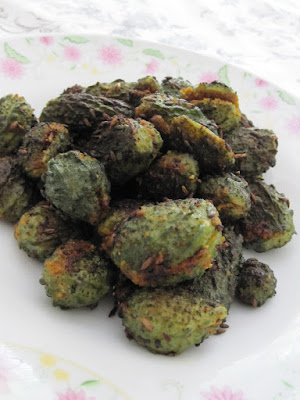
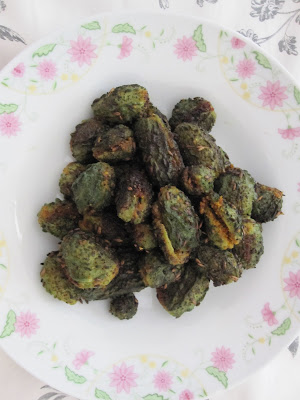
Bharwa Karela (Stuffed Baby Bittergourd)


Bittergourd is one of those vegetables that I am sort of indifferent to. I can't profess undying love for this cucurbit. At the same time, I will not suddenly decide to participate in a 100m dash just because this vegetable shows up on the menu. I have eaten it and enjoyed it in many ways.

Many years ago, a classmate of mine invited me to lunch and made stuffed bittergourd. I was more into baking and western cooking then and so I didn't think about asking her for the recipe. This time when I brought home a bag of baby bittergourds, I decided to try making a stuffed version of my own, taking a cue from my stuffed lady's finger recipe.

1/4 kilo Baby Bittergourd

To be mixed together:

1 tbsp Chopped Garlic
1/4 cup Gram Flour (Besan)
1 tsp Coriander Powder
1 tsp Cumin Powder
1 tsp Red Chilli Powder
½ tsp Turmeric Powder
¼ tsp Garam Masala
1 tsp Bharwan Tawa Masala (optional)
1 tsp Lime Juice
Salt to taste

For the tempering:
2 tsp Oil
1 tsp Cumin Seeds
1/4 tsp Asafoetida

Wash the bitter gourds well and dry on a towel until completely dry. Chop the two ends off for each gourd. Slit each gourd lengthwise and scoop out the seeds. Heat 4 cups of water and add some salt to this. Add the slit gourds and boil for 5 minutes. Drain and cool.

Stuff the prepared mixture into the bittergourds.


In a pan, heat the oil and add the cumin seeds. When they crackle, add the asafoetida and the stuffed bittergourds. Cover and cook on a low flame till the gourds are done (about 15 minutes). Remove the lid and allow to crispen.

I could eat a bowl of this as it is. That is how good it is. It definitely has some bitterness, which I don't mind. But apart from that, it is tangy and spicy and just what a side dish needs to be.

August 24, 2011

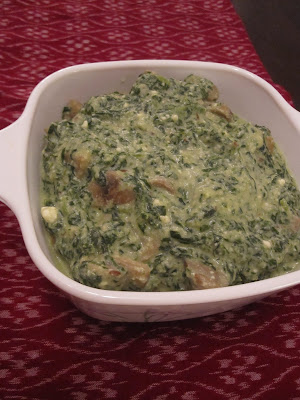
Methi Mushroom Malai


There are simple dishes. There are yummy, creamy, restaurant-like dishes. And then there are those that are both. The ones that are both are not common. This is one of those dishes. Simple to make and yet classy affairs. I had gotten bored of our rice-dal-vegetable-sambar-rasam routine and was craving something different. I had all the ingredients on hand and made this last night. The perfect accompaniment to hot rotis.

2 cups Fenugreek Leaves, washed and chopped
½ tsp Cumin Seeds
2 cups Mushrooms, quartered
½ cup Milk
2 tbsp Cream
¼ tsp Sugar (optional)
1 tbsp Oil + 1 tsp Oil
Salt to taste

To be ground to a paste:
1 Onion
2 Green Chillies
½” piece Ginger
2 cloves Garlic
2 tbsp Cashews
1 tsp Poppy Seeds (optional)
Saute the mushrooms in one teaspoon of oil. Keep aside.

Heat the tablespoon of oil in a pan and add the cumin seeds. When they crackle, add the fenugreek leaves and fry for a couple of minutes. Add the paste and fry for 2-3 minutes. Add the milk, cream, sugar, salt and mushrooms. Cook for 3-4 minutes. Serve with rotis.

June 6, 2011

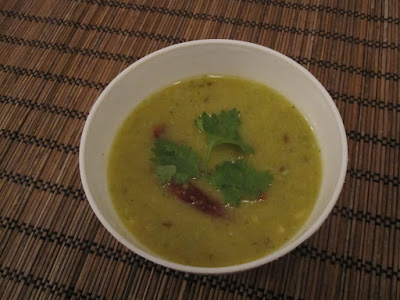
Green Masala Dal


Dal is almost a staple in our house. I don't make it everyday, but I make it very often. On days when it is pasta/noodles or anything other than rice and roti, dal doesn't make an appearance, but it is there to grace our meals on every other occasion.

Growing up, I saw only four varieties of dal being used. Toor dal (red gram dal) was the most common. Moong dal came second and not a close second. Udad and chana dals were relagated to temperings and that was that. Whole udad and whole chana found many uses, as did whole masoor. It is only when I moved out of home that I started stocking every variety of dal available in the market and learnt how to cook with them. Split, unsplit, skin on, skin off, premixed... you get the drift, don't you?

To aid me in my quest for newer dal dishes, I bought myself a pocket book by Tarla Dalal called "Dal". I have tried several recipes of hers from this book and have never been disappointed. This is one such recipe that I have adapted from this book.

1/2 cup Toor Dal
1/2 cup Moong Dal
1/4 tsp Turmeric Powder
1 tbsp Ghee
Salt to taste

Grind to a paste:

1 cup Coriander Leaves, chopped
1/3 cup Coconut, scraped
1 Onion, roughly chopped
1" piece of Ginger
3 Green Chillies
3 cloves Garlic

Combine all the ingredients for the paste and grind to a paste using as little water as necessary.

Cook the dals with the turneric powder, salt and 3 cups of water. Drain the water, reserving 1/2 cup (or save the rest for rasam). Mash the dals well.

Heat the ghee in a pan and add the ground paste. Saute for 4-5 minutes. Add the mashed dal and the 1/2 cup of water. Bring to a boil. Serve hot with rice or rotis.

December 8, 2010

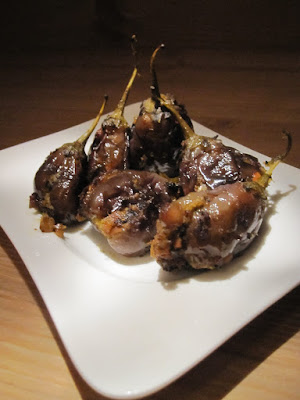
Stuffed Brinjal


The one big food related plus of having time on my hands, which was a scarce commodity barely two months ago, is being able to make dishes that require a little more time than others. It helps also to live in a city where many ingredients are easy to come by. For instance, I found this bag of almost identical sized baby brinjals   when we went grocery shopping. I bought the bag immediately, wanting to make Ennai Katrikkai. But I was missing a crucial ingredient. I decided to make this dish instead.

This dish is not a family recipe or anything like that. We had a lady working for us many years ago. One day, she asked Amma if she can make a side dish to go with chapatis. Amma agreed. She made this and all of us really liked it. It featured regularly on our menu for several years. I'd forgotten about this dish and made it just once earlier after Amma reminded me about 1-2 years ago. I made it again last week and it was gone before we knew it.

1/4 kg Baby Brinjals, slit crosswise with stems intact
2 Onions, finely chopped
2 tbsp Coconut, scraped
2 Cloves Garlic
1" piece of Ginger
1/4 cup Coriander Leaves, chopped
1/2 tsp Turmeric Powder
1 tsp Chilli Powder
1/4 tsp Garam Masala
1/4 cup Roasted Peanuts, coarsely crushed
Salt to taste
1 tbsp Oil

For the tempering
1 tsp Oil
1/2 tsp Mustard Seeds
1/4 tsp Asafoetida
7-8 Curry Leaves

Heat the tablespoon of oil and add the onions. Fry for about 3-4 minutes and add the coconut. Fry until the coconut turns brown. Grind this mixture with the garlic, ginger, and coriander leaves. Mix the turmeric powder, chilli powder, garam masala, and salt into this paste along with the crushed peanuts.

Stuff this mixture into the slit brinjals.
Heat the teaspoon of oil in a kadhai/pan. Add the mustard. When the mustard splutters, the asafoetida and the curry leaves. Add the stuffed brinjals and cover and cook for 5-7 minutes or until the brinjals are cooked. Uncover and cook for a minute or two.

Serve hot with chapatis or with some rice and dal. I could just eat this on its own. I also realized that this dish doesn't take as long to prepare as I'd imagined. Agreed that it has more steps than a simpler side dish, but it is in no way complicated.

December 3, 2010

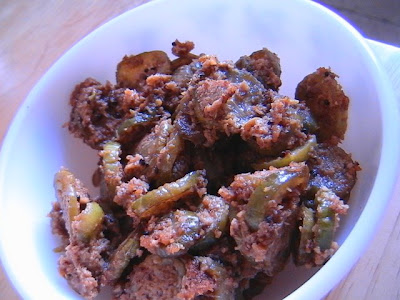
Tendlya Bhutti


Here is the dish I really wanted to send in to the RCI Udipi and Mangalore (how long ago was that?) event that Sia hosted. I just didn't make it in time. This dish is Mangalorean in every possible way. Amchi in every possible way actually. It has all the ingredients that amchis love: coconut, tamarind, jaggery, bedgi chillies and tendli! Though this is made with a little gravy (not much), I make it a little dry as S likes it that way. (Did you just buy that? Well... as always, I sauntered out of the kitchen with the dish on the stove and returned to almost no gravy!)


1 1/2 cups Ivy Gourd (Tendli/Kundru/Kovakkai/Dondekkai), sliced into discs
Salt and Jaggery to taste

For the masala:
3-4 Red Chillies (preferably Bedgi)
1 tsp Coriander Seeds
1/2 tsp Black Gram Dal (Udad Dal)
1/4 tsp Fenugreek Seeds
4-5 Garlic Cloves
3 tbsp Coconut, scraped
2 tsp Tamarind Paste
1 tsp Oil

For the tempering:
1 tsp Oil
1/4 tsp Mustard Seeds
1/4 tsp Asafoetida

Heat oil in a kadhai. Add the mustard seeds. When the mustard seeds splutter, add the asafoetida. Add the ivy gourd pieces to the oil and fry for a minute. Add the salt and jaggery, mix well and cover and cook for 4-5 minutes.

In the meanwhile, heat the teaspoon of oil for the masala and fry the red chillies, coriander seeds, black gram dal, fenugreek seeds and garlic for a minute or two. Grind this to a paste with the coconut and the tamarind paste.

When the ivy gourd pieces are tender, add the ground masala to the vegetable and mix well. Bring the mixture to a boil and cook until the ivy gourd pieces are covered with the masala and the entire mixture is a little dry.

This is a dish that you can enjoy with chapatis as much as with some rice and dali-saar.

November 10, 2010

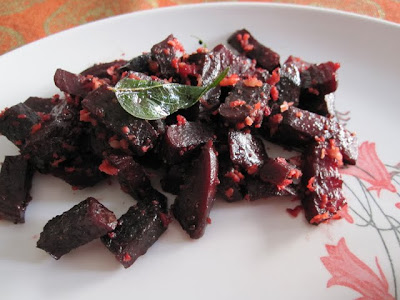
Beetroot Karumadhu


While growing up, how many times did you have to be told to eat something because it is good for you? I've lost count. Of course, I also didn't have to be told such things. I didn't quite know that  there was this option to say, "I don't want this." The only threats/coaxing I ever received had to do with the speed of my eating.

"XYZ's mother says that her hair grows long because she sits down for dinner at 8 and finishes by 8.15."

I still don't have long hair. I am still in touch with XYZ and I know she has long hair. And I know that finishing dinner in 15 minutes cannot be the only secret. And guess what? The world is talking about the benefits of eating slowly. I must admit that I do finish my meals faster than most people.

Beetroots in Indian cooking must have caused (still be causing)  a great deal of stress to children. I suppose that children are either put off by the colour or drawn to it. There cannot be a middle path. Actually, there is no middle path for adults either. What are my views on beets in Indian cooking? Beetroots are best used in salads and cakes, and of course in soups.

As far as Indian food goes, I like beets in things like chutneys. The occasional sambar or rasam with beets is a welcome change. The stir fries/sautes I deal with when I have to. That would explain why this recipe is not exactly a weekly feature in my home.


1/4 kg Beetroot, peeled and diced Steam the beetroot until tender.
1 tsp Oil
1/4 tsp Urad Dal
1/4 tsp Chana Dal
1/4 tsp Mustard Seeds
2 Red Chillies
1/4 tsp Asafoetida
1 tbsp Coconut, scraped
7-8 Curry Leaves
Salt to taste

 
Heat oil in a pan. Add the urad and chana dals, mustard seeds and asafoetida. When the mustard splutters, add the curry leaves and the red chillies. Fry for a minute. Add the chopped beets and the salt. Sprinkle a little water on top. Cover and cook for 2-3 minutes. Add the coconut and mix well.
 
This is a pretty side with the usual rice and sambar/rasam routine. Perfect when you really do need a splash of colour on your plate.


July 6, 2010

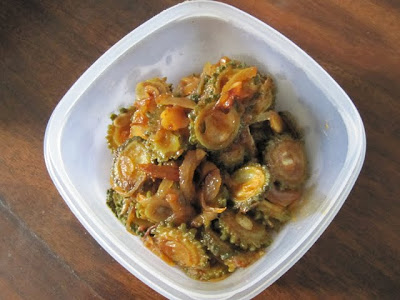
Karatya Song


Bitter Gourd! Most people hate it. Some people love it. I am one of those very few people who are indifferent to it. I can't profess undying love for the vegetable. I can never bring myself to say I don't like it. I can't  even relate to either group of people.

I have never stopped looking for recipes that are simple and use bitter gourd. Simple only because S won't touch the vegetable. And I can't do an elaborate routine just for myself, right? (For those of you who're new to this blog, I am about the laziest person you will ever come across.)

After success with the Batata Song, I decided to try this. S has been a weekend spouse for most part this summer and I conned a wholesale vegetable vendor into selling me just 4 baby bitter gourds. The result of these two seemingly independent incidents is this dish.


4 Baby Bitter Gourds, sliced and steamed
4 Onions, sliced
1 tbsp Tamarind Paste
2 tsp Red Chilli Paste
1 tsp Jaggery, grated
1 tbsp Oil
Salt to taste


Heat the oil in a kadhai. Add the onions and fry for 5-10 minutes, until the onions are evenly browned. Add the tamarind and chilli pastes. After a couple of minutes, add the bitter gourd, jaggery and salt. Add a little water. Cover and cook for a few minutes. Remove the lid and cook for another 2-3 minutes.


This is about the best way to eat bitter gourds. With some hot rotis and a bowl of cold curd, you're all set to have a lovely meal.

May 29, 2010

Batata Song (Saung)


This has to be one of the most popular konkani dishes to have been invented. Amma made it very often when we were growing up and on weekends, we would have a meal of rice, dali-saar and batata song. I can't say it is my favourite dish, but I do love it.


Amma makes a slightly different version which has coconut in it, but I tried this minus the coconut. Amma added coconut to reduce the spice quotient. I have to save my coconut reserves for dishes that absolutely need the sweet white meat. I tried the version with coconut many years ago and I made this verson recently. I always have tamarind paste at hand and I also have a bottle of red chilli paste. So, I didn't even have to grind my "massol". After having made the mushroom version of this dish, I am glad I made the original.


4 Potatoes, cooked, peeled and diced

4 Onions, sliced

1 tbsp Tamarind Paste

2 tsp Red Chilli Paste

1 tbsp Oil

Salt to taste


Heat the oil in a kadhai. Add the onions and fry for 5-10 minutes, until the onions are evenly browned. Add the tamarind and chilli pastes. After a couple of minutes, add the potatoes and salt. Add a little water. Cover and cook for a few minutes. Remove the lid and cook for another 2-3 minutes.

Serve this with some rice and dali-saar. If you grew up with this, there can be no denying the "all is well with the world" feeling that will come over you with every mouthful.

April 14, 2010

Carrot-Chayote Squash Kootu


As you've all noticed, I've gone traditional. I am enjoying picking Amma's brains of dishes that she used to make when we (my brother and I) were children. I'm enjoying recreating those dishes at home. I find that when I grind a masala for a dish that Amma's just finished telling me about on the phone, the aroma that hits my nose as soon as I open the mixer jar transports me right back to my childhood. When I get ready to eat, if my dish tastes just like what Amma used to make, then I'm all set for a trip down memory lane all through my meal.


This kootu featured rather regularly on Amma's weekly menu. While I didn't think much of it then, I'm sort of hooked now and I must say, this features quite regularly in my kitchen too.


1/2 cup Chayote Squash, peeled and diced
1/2 cup Carrot, peeled and diced


1/2 cup Moong Dal
2 tsp Sambar Powder
2 tbsp Coconut, scraped
1 tsp Cumin Seeds
1 tsp Urad Dal
1-2 Green chillies, slit
1 tsp Oil
1/4 tsp Asafoetida
Salt to taste


For the Tempering:


1/2 tsp Oil
1/2 tsp Urad Dal
7-8 Curry Leaves


Pressure cook the diced carrot and chayote squash along with the moong dal and the sambar powder.

Heat the oil in a frying ladle and add the urad dal. Fry till the dal turns golden brown. Add the slit green chillies. Grind this along with the cumin seeds and the coconut. Add this paste to the chowchow-carrot-moong dal mixture along with the salt. Add the asafoetida and mix well.


For the tempering, heat the oil in the frying ladle and add the urad dal and curry leaves. Add this to the dish and serve hot with steamed rice.


A very traditional dish to celebrate a festival. Wishing all of you a very happy new year. Iniya Puthandu Nalvazhthukkal.

April 13, 2010

Masala Keli


I joined the Great Vega'N Vegetarian project some time ago. I noticed that Cynthia had written a post about steamed plantains for breakfast. It took me back to a time (and place, more importantly) when plantains were easily available. As a child, I don't remember having eaten steamed plantains. I ate them as an adult when someone told me they made for an ideal breakfast.

This dish, however, is one that my mother dished out whenever she could lay her hands on the nendrampazham. A very typically konkani dish that is sweet, spicy and sour, all at once. I asked a colleague to get me half a dozen of these plantains and when he did, I made this.


4 Ripe Plantains (Nendrampazham/Rajali Keli), peeled and diced
3-4 tbsp Coconut
2-3 Green Chillies, finely chopped
1 tbsp Jaggery, grated
2-3 tbsp Coriander Leaves, chopped
2 tsp Tamarind Paste
Salt to taste

For the tempering:

2 tsp Oil
1/4 tsp Mustard Seeds
1/4 tsp Asafoetida
1/2 tsp Turmeric Powder


In a pan, heat the oil and add the mustard seeds. When they splutter, add the asafoetida and the turmeric. Add the green chilli and the diced banana pieces and fry for a couple of minutes. Add the rest of the ingredients and cover and cook for 4-5 minutes. Remove the cover and allow the banana pieces to caramelize a bit.


Enjoy this dish for breakfast or as a tea time snack. I can't seem to ever have enough of this. Let me know what you think.

March 21, 2010

Zucchini Moong Dal


Since I had to cook fairly traditional meals over the last three weeks, I did a lot of “food-processing” over the weekends. I peeled kilo after kilo of sambar onions that I brought back from Bangalore, diced carrots, beetroots and zucchini and chayote squash, chopped beans and cabbage and filled my freezer with different “vegetable mixes” – for sambar, avial, kootu and pulao, in addition to everything else. I used to do this sort of thing earlier (in my somewhat more organized avatar) and I stopped when I started paying my maid to chop vegetables for us. Now, I find it easier to do things myself than explain to my perennially appearing harassed maid how I want something done. One side of me begs me to not “waste” my weekends, but the more practical side of me tells me I should know better than to have vegetable related stress on a weekday.


Zucchini is in season. And it is has been robbed of its “exotic vegetable” status. When a vegetable is sold at the same price as or cheaper than the other seasonal vegetables, it can’t retain its exotic tag for very long. Not in my books, at least. And that is the same fate that Zucchini met with in my kitchen this spring. I am surprised I haven’t made sambar with mushrooms yet, but then again, mushrooms didn’t exactly reach the price nadir this year.


I opened my freezer to find a bag of frozen Zucchini and decided to make lunch with it. This dish turned out to be finger licking good and we mopped it up with rotis at lunch.


2 meduim sized Zucchini, chopped

1/2 cup Moong Dal, washed

1 tsp Oil

1/4 tsp Cumin Seeds

1/4 tsp Asafoetida

7-8 Curry Leaves

1 Green Chilli, slit

1/4 tsp Turmeric Powder

1/2 tsp Chilli Powder

1/4 tsp Cumin Powder

1/4 tsp Coriander Powder

Salt to taste


Heat the oil in a pressure pan. Add the cumin seeds and asafoetida. When the cumin crackles, add the curry leaves and green chilli and fry for a minute. Add the dal and saute for another minute before adding the turmeric and chilli powders. Add the zucchini pieces and salt along with the cumin and coriander powders. Add 1 cup of water and cover and cook for 1-2 whistles. Garnish with coriander leaves if you like.


Serve hot with rice or rotis.

March 5, 2010

Winter Vegetable Sukke


I make a lot of mixed vegetable dishes, especially in winter. I’ve gone on endlessly about how I like a colourful plate. I found a whole bunch of vegetables that needed to be used up, and quickly. It was time for my weekly vegetable purchasing spree and I had just 1-2 pieces of each vegetable left in the crisper. I made this dish for lunch and used one vegetable of every variety I had on hand. I ended up using seven vegetables. Feel free to use any combination of vegetables for this dish. I’ve found that winter vegetables lend themselves very well to this preparation.


1 Radish, peeled
1 Beetroot, peeled

1 Red Carrot, peeled

1 Purple Carrot, peeled

1 Turnip, peeled
1Potato, peeled and quartered
1Onion, quartered
1/2 tsp Fenugreek Seeds
1/2 tsp Coriander Seeds

1/2 tsp Urad Dal
1 tsp Oil
1/4 cup Coconut
3-4 Red Chillies
1 tbsp Tamarind Paste
1/4 tsp Turmeric
Salt to taste

For the tempering:
1 tsp Oil
1/4 tsp Mustard Seeds
1/4 tsp Asafoetida
7-8 Curry Leaves

Cut the radish, carrots, turnip and beetroot into 2" long pieces. Pressure cook all the vegetables with a little salt for 1-2 whistles.

Heat the oil and fry the fenugreek seeds, urad dal and the coriander seeds for a minute. Grind this along with the turmeric, tamarind, coconut and red chillies to a somewhat fine paste. Add this paste to the cooked vegetables and add salt to taste. Cook for 4-5 minutes.

Heat the teaspoon of oil for the tempering in a frying ladle. Add the mustard and the asafoetida. When the mustard splutters, add the curry leaves. Add this tempering to the vegetable mixture. Serve hot with rice and
dali-saar or with chapatis.

December 29, 2009

Palak Methi Masoor Dal


Winter! I absolutely love this time of the year. Probably not as much for the festive season as for the array of winter vegetables that I see each time I visit the markets. I find fruit and vegetable shops most visually appealing at this time. Summer can be quite depressing as you only mostly see varying shades of green and not the red, yellow, orange, purple and green that you see in winter.


I buy fenugreek leaves and fresh spinach every week and use them in several ways. Some conventional, some very unconventional. One evening, I was pressed for time as I got home almost an hour later than usual and I made this dal to go with rotis. Simple as it was, we were licking our fingers at the end of the meal.


1/2 cup Masoor Dal, pressure cooked with 1.5 cups of water

1/2 cup Fenugreek leaves, chopped

1/2 cup Spinach leaves, chopped

1 tbsp Ghee/Oil

1 Red Chilli

1 tsp Green Chilli Paste

1 tsp Ginger-Garlic Paste

1 tsp Cumin Seeds

1 tsp Asafoetida

1 Onion, finely chopped

1 tsp Turmeric

1/2 tsp Chilli Powder

Salt to taste


Heat the ghee/oil in a vessel. Add the cumin seeds and asafoetida. When the cumin crackles, add the red chilli, onion, ginger-garlic paste, green chilli paste, turmeric, chilli powder and salt. Fry for a couple of minutes. Add the fenugreek and spinach leaves and fry for about 4-5 minutes. Add the cooked dal and bring the mixture to a boil. Simmer for a few minutes and serve hot.

December 27, 2009

Radish-Broccoli-Onion-Potato Sukke


Elaborate lunches. They get pushed to weekends. When the weekend comes, they get pushed back into the next week. This kept happening for quite a while before I realized that we were eating one pot meals all the time. One weekend, I decided to fix this issue and made a konkani meal. Sukke, dali-saar and rice. Not elaborate by any standards, but when all your other meals are pulaos or mixed rice dishes or roti and sabzi at best, this meal, simple as it might be, comes as a much needed whiff of fresh air.


Sukke is a dish that was a staple at Amma's place, more as a side for chapatis than with rice and dali-saar. I added whatever vegetables I wanted to use up and I was rather happy with the result. I tend to use broccoli florets a lot and the stalks always seemed to only get used in soup. Now, I am bursting with ideas to use broccoli stalks in many ways.


1 Radish, peeled

1/2 cup Broccoli stalks, peeled

2 Potatoes, peeled and quartered

2 Onions, quartered

1/2 tsp Fenugreek Seeds

1/2 tsp Coriander Seeds

1 tsp Oil

1/4 cup Coconut

3-4 Red Chillies

1 tbsp Tamarind Paste

1/4 tsp Turmeric

2 tsp Jaggery (optional)

Salt to taste


For the tempering:

1 tsp Oil

1/4 tsp Mustard Seeds

1/4 tsp Asafoetida

7-8 Curry Leaves


Cut the radish and the broccoli stalks into 2" long pieces. Pressure cook the radish, broccoli stalks, onions and potatoes with a little salt for 1-2 whistles.


Heat the oil and fry the fenugreek seeds and the coriander seeds for a minute. Grind this along with the turmeric, tamarind, coconut and red chillies to a somewhat fine paste. Add this paste to the cooked vegetables and add salt to taste. Add the jaggery, if using. Cook for 4-5 minutes.


Heat the teaspoon of oil for the tempering in a frying ladle. Add the mustard and the asafoetida. When the mustard splutters, add the curry leaves. Add this tempering to the vegetable mixture. Serve hot with rice and dali-saar.

December 4, 2009

Soya Makhani


When we moved to this new apartment, I somehow didn't manage to cook anything decent for the first few days. But we still took our lunch packed in boxes. The lunches usually had soya, paneer, peas, lentils... you get the drift, don't you? Since Amma and Appa were here then, Amma would make dinner each night and that was the only meal which gave us our vegetable fix.


Soya makhani is one such dish that was put together in less than 10 minutes. Thanks to soya chunks and bhuna masala. This is kind of like the vegetarian version of butter chicken, but made completely the cheater's way.


1 cup Soya Nuggets, prepared according to instructions on the pack

1 packet Maggi Bhuna Masala for Gravy Dishes

1/2 cup Milk

1/2 tsp Turmeric Powder

1 tsp Chilli Powder

1 tsp Dried Fenugreek Leaves (Kasuri Methi)

Salt to taste


Heat the bhuna masala in a kadhai and add the chilli powder, turmeric and salt. Fry for a minute.


(If you do not have access to Maggi Bhuna Masala, you could heat a tablespoon of oil, fry the paste of 1 onion along with a teaspoon of ginger garlic paste. After the onion paste is fried for 3-4 minutes, add 2-3 tbsp of tomato puree and cook for 2-3 minutes more.)


Add the milk and bring the mixture to a boil over a low flame. Add the soya nuggets and cook for a couple of minutes. Add the dried fenugreek leaves and take off the flame. Serve hot with rotis.

November 22, 2009

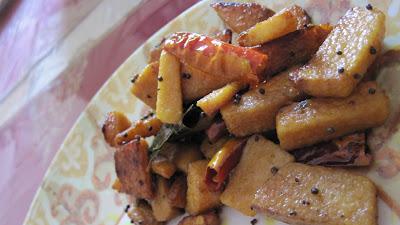
Senaikkizhangu Karumadhu (Yam Saute)


I've talked often about how I eat everything, all fruits and vegetables and all kinds of foods without exception. There are some things I know I like and there are some things I like simply because my dear brother, H, couldn't stand them. The opposite of this also held true for quite a while. I didn't "like" lady's finger simply because he loved it. Yam was (and still is) the one vegetable he absolutely hated. I liked it as a child, but I continue to relish it as an adult as well. I made this saute, a staple at my parents' home, recently. And then I made it again.


Here's the recipe, handed down from mother to daughter and then from daughter to the world!


2 cups Yam, peeled and diced

3-4 Red Chillies

1/4 tsp Turmeric (optional)

1 tbsp Tamarind Paste

1 tsp Oil

Salt to taste


For the tempering:

1 tbsp Oil

1/2 tsp Mustard Seeds

1/4 tsp Asafoetida

7-8 Curry Leaves


Pressure cook the yam with the tamarind paste, turmeric (if using), salt, chillies and a teaspoon of oil with 3 cups of water. Drain the water.


In a kadhai, heat the tablespoon of oil. Add the mustard seeds and asafoetida. When the mustard splutters, add the curry leaves and the drained yam.


Saute for a minute, cover and cook for 4-5 minutes. Remove the lid and allow the pieces to crispen. Serve hot with some rice and sambar, your meal is complete!


Please also remember that the Tried and Tasted (Sunshine Mom's Blog) is on at The Singing Chef. Do send in your entries.

November 14, 2009

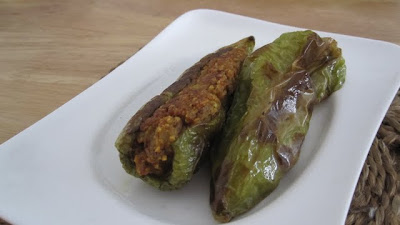
Baked Stuffed Chillies


I have always avoided buying chillies. But I usually end up with a bag of the "bajji" variety chillies in the hope of making mirchi bajji. I have made that once (but sadly, the post languishes in my drafts) and the other times that I bought the chillies, I saved the bag from going into the trash by making this once and this the other time.


Today was a little different. I was quite determined to use up the chillies in a different manner before they turned into something unrecognizable. I had some aloo paratha stuffing left over and I modified it to stuff these chillies.


6 large Chillies, slit and deseeded

2 Potatoes, cooked and mashed

1 Onion, chopped finely

2 tbsp Coriander Leaves, chopped

1/2 tsp Garam Masala

1 tsp Chilli Paste

Salt to taste

To be ground:

1/4 cup Roasted Peanuts

1/2 tsp Amchur

1/2 tsp Coriander Powder

1 tsp Cumin Seeds

1 tsp Chilli Powder

1 tbsp Oil


Mix the potato, onion, coriander, garam masala, salt and chilli paste. Add the ground mixture and mix well.


Preheat the oven to 250 C. Use a little oil to grease a baking tray. Stuff the potato-peanut mixture into the chillies and arrange them on the tray. Brush the chillies with the remaining oil. Bake for 15 minutes, turning once in between.


This makes a wonderful side dish with some rice and dal, but as we discovered this afternoon, it is a finger licking good accompaniment to beer.

September 13, 2009

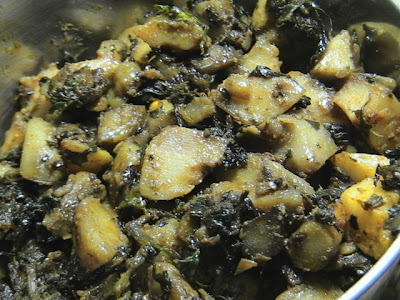
Aloo Methi


I was first introduced to Aloo Methi when I was about 10 or so. My eldest cousin married into a North Indian family and when we visited her, she served us this with hot phulkas. Fortunately, she warned me that it might be a little bitter. I guess I was prepared for the worst. As it turned out, I ended up loving this dish. I make it at least 1-2 times a month when fresh fenugreek leaves are in season.


3 Potatoes, boiled, peeled and diced

1 cup Fenugreek leaves, chopped

1 tsp Oil

1 tsp Cumin Seeds

1/4 tsp Asafoetida

1 tsp Chilli Powder
Salt to taste


Heat the oil in a kadhai. Add the cumin seeds and the asafetida. When the cumin crackles, add the fenugreek leaves and sauté for a minute or so. Add the salt and chilli powder and cook for another minute. Add the diced potatoes and mix well. Cover and cook for 5-7 minutes.


This is one of those “perfect sides” with rice and dal or rotis.

September 3, 2009

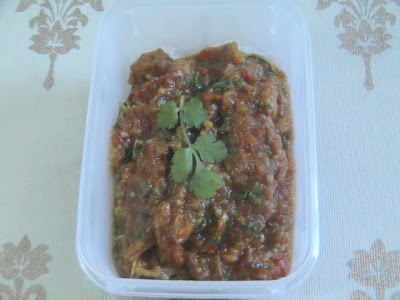
Baingan Bharta


I didn't always like the taste of smoked brinjals. I love brinjals otherwise, but this one method of cooking was never a favourite. If Amma wanted to make thogayal/thuvayal, she would steam the brinjals in the cooker. Now, I have come to appreciate the flavour a lot more. When Amma was here sometime back, she made this Baingan Bharta. Even my Punjabi colleagues said it was to die for.


1 large Brinjal, roasted on an open flame

1 Onion, chopped finely
1 Tomato, chopped finely
1 tsp Ginger Paste
1 tsp Chilli Powder
1/4 tsp Turmeric Powder
1/2 tsp Coriander Powder
1/4 tsp Garam Masala
1 tsp Oil
Salt to taste


Place the roasted brinjal in a bowl of water.
Remove the charred skin and keep the brinjal aside. Mash the cooked brinjal a little.


Heat the oil in a kadhai. Add the onions and fry for a couple of minutes. Add the ginger paste along with the turmeric, coriander and chilli powders. Add the salt and the tomato and fry for 3-4 minutes. Add the mashed brinjal and cook for another 3-4 minutes. Add the garam masala and garnish with some chopped coriander if you like.
Serve hot with chapatis/phulkas.