Google
 
Showing posts with label colocasia (arbi/seppankizhangu). Show all posts

December 1, 2008

Announcing Think Spice with Masala Arbi Fries


There are loads of spices on my kitchen shelves. Spices, herbs, condiments, spice mixes, the list is endless. But I tend to stick to the same old tried and tested spices while cooking. For ages, I've had a bottle with small packets of different spices: ajwain, shahjeera, anardana and kalonji. This bottle traveled with me from Hyderabad to Bangalore to Gurgaon. I hardly used the contents of this bottle until sometime last year. No prizes for guessing what brought that about.


I now use these different spices in my cooking and have gone beyond the usual cinnamon-clove-cardamom routine. Sometime last year, Sunita started the Think Spice event and I think I tried to participate in each edition until Kaykat chose Wasabi. Sometime around then was also when we went on vacation and my blog suffered a bit as a result of that. A few months ago (or was it a year ago?) I signed up to guest host the December edition of Think Spice. So, here I am. And my choice of spice this month is Carom.


Also known as Ajwain/Omam/Owa/Vaamu, this spice is used in many dishes. I've seen it used most with ingredients that are likely to cause flatulence as this, quite like asafoetida. So, while I've seen it being used in Oma Podi in Madras, in Gurgaon, this spice goes into pakodas and parathas. I use it in some side dishes with vegetables like potatoes or colocasia, and at times temper dal with it. So get ready to cook with carom this month.

  • Post a recipe of any kind, using the chosen spice, also, in any form you desire (seeds, powder, bark, etc). Feel free to share all your thoughts and information on the chosen spice.
  • Include a link back to this post for the benefit of your readers and future references.
  • Email me your entry with your name, a picture of your dish and the permalink of your recipe by or before the announced deadline to onlineraga@gmail.com with the subject -Think Spice...Think Carom.
  • Non -Bloggers are also welcome to participate. Just e-mail me your entry with a picture to onlineraga@gmail.com.
  • The round ups will be posted during the first week of January.
  • Feel free to use the logo.


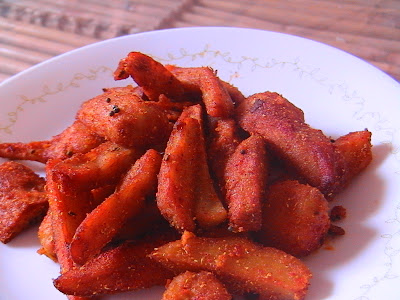
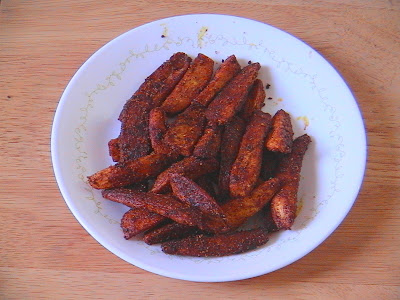
Here's an easy dish to get you started. This is perfect finger food. Indian style fries if you may!

1/4 kg Colocasia, peeled and quartered lengthwise

1-2 tbsp Oil, for shallow frying

1 tsp Carom seeds

1 tsp Cumin-Coriander Powder

1 tsp Chilli Powder

1/4 tsp Turmeric Powder

1/4 tsp Garam Masala

2 tsp Oil

Salt to taste


Heat the oil in a frying pan and shallow fry the colocasia pieces until lightly browned. Drain on absorbent paper.


Heat the 2 teaspoons of oil in the same pan. Add the carom seeds and fry for a minute. Add the turmeric powder, chilli powder, and cumin-coriander powder and fry for a minute or so. Add the fried colocasia pieces and toss well. Add the salt and the garam masala. Cook for 4-5 minutes.


Enjoy this as a snack with tea, or as finger food with drinks. It is a hit either way. Now let me enjoy this plate of fries while I start waiting for your entries to come in.

May 4, 2008

Arbi Ka Saag


For a long time, I knew of 3 ways in which I could make Arbi (Colocasia). I could make Seppankizhangu Fry (Deep Fried), Seppankizhangu Karumadhu, and Seppankizhangu Mor Koottu. All Tamil dishes. So, I'd buy the vegetable only if I knew I was going to make Sambar sometime soon. I never thought I could make a side dish to go with rotis.

When I came across this recipe, I was a bit skeptical about how well it would pair with rotis given how dry it looked. I was pleasantly surprised when not only did I think my lunch was great, my colleagues kept picking pieces off my plate, and S called from work to say, "You should make this more often!"

As with most Rajasthani recipes here, this is also adapted from the Rajasthani Cookbook by Tarla Dalal.

250 g Colocasia (Arbi/ Seppankizhangu), boiled, peeled and quartered
1/4 tsp Carom Seeds
1/4 tsp Mustard
1/4 tsp Turmeric Powder
1 tsp Chilli Powder
1/2 tsp Coriander Powder
Juice of 1 Lime
1 tsp Oil
Salt to taste

Oil for deep/shallow frying


Shallow fry or deep fry the arbi pieces and keep aside.

Heat the teaspoon of oil. Add the carom and mustard seeds. When the mustard splutters, add the fried arbi pieces, turmeric, chilli and coriander powders, salt and lime juice. Mix well.

Serve hot with rotis.

I deep fried as I made it in the morning when I was short of time. I didn't want to shallow fry then as it really is time consuming. This is off to Padmaja at Spicy Andhra as my second entry to the RCI Rajasthan - Flavours of the Desert event.

August 31, 2007

Patrodo

There are dishes that give me mental fatigue. That is only to say that just thinking about making the dish makes me tired, because in my mind the process is a lengthy one. Patrodo is a perfect example.


We had the colocasia leaves growing in our garden when I was a child. Every once in a while, we'd go through the routine of cutting the leaves, making the masala or massol as it is called in Konkani. H and I would always be assigned the job of destemming the leaves. What fun! More fun because we could play the blame game whenever a leaf was cut or got beaten beyond repair. We would cut the stem by marking a V at the base of the leaf and then string the leaves. After this we would lightly beat the veins using a rounded smooth stone.


I made this when I found colocasia (taro) leaves at the INA market. It is much simpler than I imagined. The result is superb and so the work that goes into it feels like nothing at all.


Ingredients:


7-8 Colocasia (Arbi) Leaves
1/2 cup Rice
1/2 cup Dal
7-8 Red Chillies
1/3 cup Coconut, scraped
1/4 cup Tamarind Paste
1 tsp Turmeric Powder
1 tsp Asafoetida
2 tbsp Jaggery
Salt to taste


For the tempering:

1 tbsp Oil
1/4 tsp Mustard Seeds
1/4 tsp Asafoetida
7-8 Curry Leaves

Soak the rice and dal together for at least 4 hours.


Destem the leaves and flatten the veins using a rounded stone.


Grind the rice and dal together along with all the other ingredients except the leaves.


Place the largest leaf on a clean surface, smooth side down and smear the paste over the leaf.


Place the next leaf over this in such a way that the tip of the leaf is near the base of the one below.


Smear the paste over the leaf and place another pointing in the opposite direction and proceed in the same manner until you have used the smallest leaf.


Fold the sides of the leaves inwards and smear more paste. Roll the leaves in a swiss roll like manner and tie with a string.


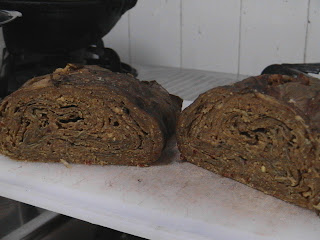
Steam cook this bundle in a cooker without using the pressure for about 30 minutes. When done, it should look like this.


Cool completely and cut into slices after removing the string.


To proceed, heat the oil in a kadhai. Add the mustard seeds and asafoetida. When the mustard splutters, add the curry leaves. Add the slices of patrodo and fry for a few minutes allowing the slices to crispen.

Amma says that there are variations here. The slices may be deepfried or toasted on a tawa. I like my patrodo with tadka and I love it with rice and dali saar.

You could adjust the tamarind paste int he recipe to suit your taste. The tamarind helps remove the itchiness that these leaves cause. Also, the leaves with purple stems cause less itching than the ones with green stems.


The partodo rolls may be made in advance and frozen. When you are ready to eat them, bring them out from the freezer, thaw them and then proceed. I have yet to make the final dish. Am saving the rolls in my freezer for an evening when I return from NOIDA so tired that all I want to do is eat dali saar and fry patrodo. And believe that all is well with the world.


Rice being the one of the ingredients here, I am also sending this entry to Jihva for ingredients started by Indira of Mahanandi and hosted by Sharmi of Neivedyam.


As this is a Konkani dish, I am sending it to Asha for the RCI Karnataka, an event started by Laksmi that celebrates the regional cuisine of India.

August 8, 2007

Taro-Rice Balls with yogurt dip


What do you do with leftovers? Left over curry, left over rotis, left over rice. I always try to do something. And I’m always looking for ideas. Some years ago, while I was at a Gujarati Restaurant in Hyderabad called Indian Harvest, my thali had a rather unusual fried snack. Small cutlets made with cooked rice and spices. I tried making the stuff at home and they turned out very nice.

Taro Root (Colocasia) is made in several ways in Tamil cuisine. I have talked about Seppankizhangu Karumadhu(Colocasia Curry) and the Seppankizhangu Mor Koottu earlier. The third way is to deep fry cooked taro root pieces smeared with spices. I had some left over curry and decided to convert it into the deep fried version on S’s birthday. But I also had leftover rice. And I didn’t know what to do with that. And what do I make to complete the meal?

It struck me just then. I thought, “Why not combine a Gujarati snack and a Tamil side dish into one?”

Ingredients:

1 cup Seppankizhangu Karumadhu
1 cup Cooked Rice
1 tsp Chilli Powder
½ tsp Turmeric Powder
¼ cup Flour
Salt to taste
Bread crumbs or Rava to coat
Oil for deep frying

If you don’t have the ready made curry, you can use cooked taro root and increase the salt, turmeric and chilli powder accordingly.

Mash the taro root curry along with the cooked rice. Add the salt, chilli powder and turmeric powder. Make small balls out of this mixture.

Mix the flour with a little water to make a thin paste.

Roll the balls in this paste and coat with breadcrumbs.

Heat the oil in a kadhai and deep fry these balls till they turn golden brown.

Drain on a slotted spoon over another small vessel so that this oil can be reused.

Yogurt dip:

1 cup Curd, beaten
½ Cucumber, grated
1 Onion, chopped finely
½ tsp Chilli Paste
½ tsp Ginger Paste
½ tsp Chilli Flakes
¼ tsp Oregano Flakes
Coriander leaves for garnishing
Salt to taste

Mix all the ingredients well. Garnish with coriander leaves. I got the idea of using oregano and chilli flakes from Nandita’s entry for WBB#12.

And since this becomes a complete meal in itself and is ready in way less than 30 minutes, this goes to Mallugirl’s Express Cooking challenge.


Rice being used here, I am also sending this entry to Jihva for ingredients started by Indira of Mahanandi and hosted by Sharmi of Neivedyam.

Seppankizhangu Karumadhu (Colocasia Dry Vegetable)


There are comfort foods and there are comfort foods and then there's seppankizhangu karumadhu. I love eating hot rice with sambar or rasam over it and loads of this vegetable on the side.

People think it is gooey and itchy and a lot of things. I think it's heavenly. I mean, how can something so simple be so tasty. A staple in my dad's side of the family, my mom's side uses the leaves to make patrodo, but never uses the root. I made this when my cousin and his family came over for dinner last week. And everyone loved it. And everyone wanted to "help" and ran the spoon over the curry to "mix" it, so the resultant curry was a mash. But when I browned it evenly, it didn't seem to matter.

Ingredients:

1/2 kilo Colocasia, cooked and peeled.
1 tbsp Oil
1/4 tsp Mustard Seeds
1/4 tsp Asafoetida
7-8 Curry Leaves
1/2 tsp Urad Dal
1/2 tsp Chana Dal
1 tsp Chilli Powder
1/2 tsp Turmeric Powder
Salt to taste

Chop the colocasia into small discs. Apply salt, chilli powder and turmeric powder and keep aside.

Heat the oil in a kadhai. Add the urad and chana dals. When the urad dal begins to change colour, add the mustard and asafoetida. When the mustard splutters, add the curry leaves and the colocasia pieces. Mix once and cover. Allow to cook for 5 minutes.

Remove the lid and allow the pieces to crispen on all sides. Do not mix it too many times as you the risk of mashing the entire dish into one big mass. Enjoy this with sambar or rasam rice.

June 21, 2007

Seppankizhangu Mor Koottu


Seppankizhangu, colocasia, arbi... call it what you like. This is again one of those vegetables that people either love or hate.

In south indian homes, the deep fried version and the shallow fried version are most popular. I was discussing this dish with my friends on Saturday, and none of them had even heard of it. I blamed it on their being Iyers and not being exposed to Iyengar food and one of them said, "I have a very close Iyengar friend and I know all about their cooking." Most people tend to think that my ideas about food are pretty messed up thanks to my mixed parentage. But I firmly believe that food is handed down from one generation to the next. And sometimes certain dishes are not made at all in some households because one or two people gave them up at Kashi or just happen to not like them.


Anyway, this dish brings back fond memories of Sunday lunches at IIT Madras. Rice, yela paruppu (thick dal), seppankishangu mor koottu, rasam, vattal-vadam (rice crispies). Ah... bliss!

Ingredients:

1/2 kg Colocasia tubers, boiled and cut
2-3 tsp Urad Dal
2-3 Green Chillies, slit
2 tbsp Coconut, scraped
1/2 Cup Curd
1 tsp Oil
Salt to taste

For the tempering:
1 tsp Oil
1/4 tsp Mustard Seeds
1/4 tsp Asafoetida
4-5 Curry Leaves

Heat the oil in a kadhai and roast the urad dal and green chillies. Transfer this to a mixer jar and grind with the coconut and salt. Transfer this mixture to a bowl and blend with the curd. Add the boiled colocasia pieces.

For the tempering, heat the oil in a small kadhai. Add the mustard seeds and asafoetida. When the mustard begins to splutter, add the curry leaves. Add this to the curd - colocasia mixture.

Eat this with paruppu saadam (dal rice) and some vattals along side. See you when you return to earth!