Google
 

Friday, September 28, 2007

Vazhaikkai Podimas


Bananas. One of those fruits people love or hate, but can't ignore. I have a funny relationship with the banana. And I haven't given it a name yet. I am not fond of the small yellow bananas and love the green ones. But the green ones give me acidity, so I don;'t know what to do. The yelakki variety that I got in Bangalore I absolutely love. And can eat those without thinking twice.


As a raw vegetable, the possibilities are endless. Raw banana fritters made this way, vazhakkai karumadhu and chips of course. But all these are oil intensive and there are times when I want my fill of banana without the fat. And it is at such times that I crave podimas.


This recipe is adapted from Samaithu Paar.

2 Raw Bananas, steamed and peeled

2 Red Chillies

2 tbsp Urad Dal

2 tbsp Chana Dal

1/4 tsp Asafoetida

Salt to Taste

a few drops Oil


Heat the oil and roast the urad and chana dals. Add the red chillies and the asafoetida. Cool completely and grind to a powder.


Place the powder on a large plate and mash the bananas onto the powder. Add salt and mix thoroughly. Enjoy this with hot rice or as a side dish with rice and
sambar.


Off this goes to Mandira of Ahaar for her JFI - Banana Event.


Nags
had asked all of us to show her our cookbooks. I have so many cookbooks now that it is difficult to pick one and showcase that as a favourite. There are cookbooks that I'd consider favourites which I've left behind when I was moving here. They wait patiently for my return. But since the entire month of September was dedicated to amchi cuisine, I am showcasing the book that I referred to the most in this month.


Written by Ambabai Samshi, this book would classify as the Bhagvad Gita for anyone who is looking to learn Chitrapur Saraswat cooking. I have to reduce the spices a great deal, but when I follow a recipe, I can be certain that it will taste just like the food Amma or my aunts prepare.

Thursday, September 27, 2007

Goodies for Ganpati: Kozhukattais: Uppu & Ammini


Ganesh Chaturthi is a huge festival on my mother's side of the family. My father is an Iyengar (Vaishnavite) and so this is technically not a festival. But it has been celebrated at his place. However, there is no culinary tradition relating to this festival on his side of the family. But growing up in a multicultural home in a multicultural surrounding (IIT Madras) meant that I got to celebrate more festivals than were celebrated on either side of my family.


I am not too fond of the sweet kozhukattais. And I had made Patoli and Narlya Kheeri just the day before Chaturthi. I wanted to make the savoury kozhukattais that I've eaten at friends' places or brought home from work by Amma. I didn't fare too well on my first attempt at making kozhukattais. But I tried again the very next day and got a nice pliable dough. Lakshmi and Latha from The Yum Blog helped me understand what may have gone wrong.


I had invited a few people for dinner that evening and wanted to have a good mix of sweet and savoury items. The world knows that I was eyeing Laavanya's Ammini Kozhukattai ever since she posted it. I had never heard about it, let alone eat it. But the thought of small rice pearls with a savoury tempering made my mouth water.


I didn't soak and grind rice flour as Laavanya's method suggests. Instead, I made the dough for the outer covering of a kozhukattai from The Yum Blog.


3 cups Rice flour
3 cups Water
1 tbsp Oil


Salt to taste


Bring the water to a boil in a heavy pan. Add the oil, salt and rice flour and stir well. Take off the flame and mix to a smooth dough like consistency. Cover and cool.


For the Ammini Kozhukattai:


1 tsp Oil
1/4 tsp Urad Dal
1/4 tsp Chana Dal
1/4 tsp Mustard Seeds
1 Red Chilli


1 tsp Green Chilli Paste
1/4 tsp Asafoetida
1 tbsp Coconut, scraped
7-8 Curry Leaves
Salt to taste


Make small balls of the dough and steam in a greased pan for 10 minutes.


Heat oil in a kadhai. Add the urad and chana dals, mustard seeds and asafoetida. When the mustard splutters, add the curry leaves, green chilli paste and the red chillies. Fry for a minute. Add the steamed balls, coconut and the salt. Cover and cook for a couple of minutes.


I didn't have time to look at Laavanya's blog for the exact recipe, but I am fairly certain I was pretty close to the original. The dish turned out superb.


For the Uppu Kozhukattai:

1/2 cup Urad dal
1 tsp Green Chilli paste
7-8 Curry Leaves, finely chopped
1 tbsp Oil
1/4 tsp Asafoetida
Salt to taste
1/4 tsp Mustard Seeds


Wash and soak urad dal for half an hour. Drain well and grind coarsely adding 2 table spoons water.

Heat the oil in a kadhai and add the mustard seeds and asafoetida. When the mustard splutters, add the curry leaves, green chilli paste, salt and the ground urad dal.

Cook for 3-5 minutes on a low flame.

Take a small amount of dough, flatten it on your greased palm and make a small cup. Add a little urad dal filling and bring the edges together. Seal at the top and keep aside. (I flattened these because I was going to steam them in my idli mould!)


Steam on a greased idli/idiyappam stand or just any vessel for 4-5 minutes. Aren't they just perfect little beauties?


I am sending these to Viji as my first entry for the RCI - Tamil Festival event. I am also sending this to Latha for her Gowri Ganesh event.

Wednesday, September 26, 2007

Masala Appey

I can't seem to find a better name. The day that Nandita of Saffron Trail announced her Weekend Breakfast Blogging # 15, I had already made these for breakfast. So I knew exactly what I was going to send her.

I had some Akki Roti batter and some dosa batter in the fridge. Individually, these would not have been enough to make breakfast for two. But when mixed and converted them into masala Appey.


If you have some left over dosa batter, then you can whip this breakfast up in a jiffy.
1 cup dosa batter
1/2 cup Rice Flour
1 Onion, finely chopped
1 tsp Coconut, scraped
1 tsp Chilli Paste
2 tbsp Coriander, chopped
1 tsp Oil
Salt to taste


Heat the appey patra/kayli.

Mix all the ingredients together and drop a spoonful each into each mould. Cook on each side for 2-3 minutes. Serve hot with Chutney.

Nandita, this one's for you. Happy hosting.

Tuesday, September 25, 2007

Geena Sandan (Colostrum Pudding) for a sweet ending


Today is the last day for the RCI Karnataka event. And I am sad to see it end. My posts on konkani food will continue, but I am sure the frequency will be a lot different. I tend not to cook amchi food on a daily basis.


Special events call for special dishes. A farewell is a special event. And as a sweet dish, there is really nothing that I consider more special. One of the reasons I love this pudding is probably the frequency with which I get to eat it. How often do you know of someone who has a cow? And how often does that cow give birth? And how often when that cow gives birth does that someone remember to send you the colostrum or first milk?


But there are times when all of this comes together. So the next time life hands you colostrum, you make geena sandan!!


2 cups Colostrum

3 cups Jaggery

1 tbsp Pepper, ground

4 cups Milk

1 tsp Cardamom Powder


Dissolve the jaggery in the milk and add all the other ingredients. Pressure cook for 3 whistles.


It doesn't get any simpler than this. The only difficulty here is in getting the colostrum. Once that hurdle is crossed, everything is really as easy as p-u-d-d-i-n-g.


While Asha will be busy with her round up of dishes from Karnataka that have poured in, I am presenting a mini round up of dishes that I sent to the


Carrot Kosumbari

Beans Upkari

Appey

Jeera Kotambarya Chitni

Patrodo

Besan Unde

Rulaama Doddak

Akki Roti

Cauliflower Phodiyo

Capsicum Phodiyo

Dali Saar

Chow Chow

Divkadgye Phodiyo

Patoli and Narlya Kheeri

Somashe and Chakli

Cashew Onion Pakodas

Pineapple Sasam

Vatana Ambat

Avrya Bendi

Madgane


More dishes that call Karnataka home on The Singing Chef:


Tomato Saar
Tandlya Roti Ani Lasnye Chitni
Biscuit Roti
Ambya Sasam
Rasayan
Tendlya Talasani
Sabudana Khichdi
Batat Phow
Bread Upkari
Chhollia Ghasshi

Green Akki Roti

And with this special dish, I bid adieu to the RCI Karnataka. Asha will probably have to give me an award for the maximum number of entries. I'm just wondering. For this event, did I have competition??

Goodies for Ganpati - Madgane


This is one of those dishes that make me wonder why some things are only made for festivals. This kheer is something that we traditionally make for Ganesh Chaturthi.


1/2 cup Cashewnuts, broken to bits
1/2 cup Bengal Gram Dal (Chana Dal)
1/2 cup Coconut Milk
1/2 cup Jaggery, grated
1/4 cup Rice Flour
1/2 tsp Cardamom Powder


Cook the bengal gram dal and the cashews in a pressure cooker with 3 cups of water. To this, add the grated jaggery and coconut milk. Add about one more cup of water and bring to a boil. Add the cardamom powder.
Mix the rice flour with a little water and make a paste. Add this to the boiling mixture and cook until the mixture thickens.
This also goes to dear Asha as yet another entry for the RCI Karnataka event. I am also sending this to Latha for her Gowri Ganesh event.

Avrya Bendi


This would go down in history as my favourite amchi dish. Everyone in my family knows how much I love bendi. And Avrya Bendi is top of the tops. Avro is very similar to the lima bean and the navy bean, though I am really not sure which it is. In Tamil, this is known as the Rangoon Mochai.


There was this one time when I took my friend to Bombay for two and a half weeks. I probably have relatives at every station on all three train suburban lines. Definitely every station from Bhayandar to Marine Lines. And I had to visit them all. And they all religiously served us the same things. Over and over again.
Batat Phow and Sabudana Khichdi if we were there at tea time and Avrya Bendi and Tendle and Bibbya Upkari (Ivy gourd and Cashew vegetable - something amchis serve to show their love for the people they are feeding.). My friend really must have thought this is the ONLY food that Konkani people eat.


1 cup Hyacinth Beans (Avro/Rangoon Mochai), soaked overnight and cooked
¼ cup Coconut, scraped
1 tbsp Tamarind Paste
2-3 Red Chillies
1 tsp Teppal (Triphala)
Salt to taste

For Tempering Version 1

1 tbsp Cooking Oil

1 tsp Mustard Seeds

½ tsp Asafoetida (Hing)

7-8 Curry Leaves

For Tempering Version 2

1 tbsp Cooking Oil

3-4 Small Garlic Pods, crushed slightly


Grind the coconut, tamarind, red chillies and a tablespoonful of the cooked beans to a fine paste.

Mix this paste with the cooked beans and add salt and a little water. Bring this to a boil.

In a small kadhai, heat the oil and add the ingredients for tempering based on your preference. (If using mustard seeds, add the curry leaves after the mustard has spluttered.) Add this to the boiling mixture and serve.


My favourite way to eat Bendi is with rice, Dali Saar, some phodiyo and upkari. And I want the world to know how I enjoy my comfort food, so this is off to dear Asha for the RCI Karnataka event.

Vatana Ambat


When Asha made her Wadi Ambat, I knew I wanted to make some ambat for myself. So I did. And I forgot all about it as it sat in my drafts.


1 cup Yellow Peas, soaked overnight and cooked
¼ cup Coconut, scraped
1 tbsp Tamarind Paste
2-3 Red Chillies
1 tsp Fenugreek Seeds
¼ tsp Oil
Salt to taste

For Tempering
1 tbsp Oil1 tbsp Onion, finely chopped


Heat the quarter teaspoon of oil and fry the fenugreek seeds for a minute or two. Grind the coconut, tamarind, red chillies and the fenugreek seeds to a fine paste.

Mix this paste with the cooked peas and add salt and a little water.

In a small kadhai, heat the oil and add the onions. Fry for 2-3 minutes and add this to the boiling mixture. Serve hot with rice.


If you're looking for a no onion/garlic version, you could use this tempering:

1 tsp Cooking Oil
1 tsp Mustard Seeds
½ tsp Asafoetida (Hing)
7-8 Curry Leaves

In a frying ladle, heat the oil and add the mustard. When the mustard splutters, add the asafoetida and turn off the flame. Add the curry leaves. Fry for a minute and add this to the boiling mixture.

I used leftovers from this to make Ragda Patties. I'd made this a long time ago and waited for the RCI event so I could send this to send to dear Asha for the RCI Karnataka event. I nearly forgot about it.

Saturday, September 22, 2007

Black Currant - Raisin Whole Wheat Muffins


A grape by any other name would taste just as grape... oops I meant great.


When Swapna announced the AFAM: Grapes event, I knew exactly what I was going to make. A low fat, low calorie dessert called Violet Fantasy. The dessert called for Tonovin Essence and that I simply couldn't find in Delhi/Gurgaon. I tried looking all over the place, but it was just not available or out of stock or whatever.


As with last month's AFAM entry, I decided to go with my Mapro crushes instead of the actual fruit. There are several reasons for this. The most important one being the absence of local grapes in the local market. I keep seeing these American grapes that cost close to a thousand bucks per kg. I wouldn't even dream of buying them (and price isn't the only determining factor here), let alone make something out of them.


Ingredients


3/4 cup Milk
1/2 cup Vegetable oil
1/2 cup Raisins
1 1/3 cups Flour
2/3 cup Atta
1/3 cup Black Currant Crush (Or Grape Crush)
1/2 cup Sugar
1 tbsp Baking Powder
1 Egg
1/4 tsp Salt


Place all the ingredients except the raisins and black currant crush in a food processor jar fitted with the dough blade. Run the food processor for 2 minutes until the ingredients form a dough.

Place the muffin moulds (butter paper) in the muffin pan.


Blend the raisins into the batter. Add the grape crush and mix lightly. Pour spoonfuls of the batter into the muffin moulds. Bake in a hot oven (400 F) for 15 minutes.


This recipe is an adaptation of my Almond Raisin Muffins which were adapted from Sharmi’s recipe for Strawberry Muffins. I reduced the sugar by half because I didn't want extremely sweet muffins and the grape crush was going to add its own sweetness too. And I even replaced part of the flour with atta making the muffins at least that much healthier. Maybe I can alter the proportions from the next time around and make it half and half. Like Anita always does.


I am sending this to Swapna as this uses grapes in two forms, raisins and black currants. Happy hosting!

Friday, September 21, 2007

Pineapple Sasam


Hot and sweet at the same time? Is that possible? Outside of Indian Chinese? Yes. Konkani food can be sweet, sour and hot all at once.

Sasam is a very simple dish made with mango, pineapple or mixed fruits.
The name is derived from the main ingredient, sasam, or mustard.

Ingredients:

1 cup Pineapple, chopped
2 tbsp grated Jaggery
Salt to taste

To be ground to a paste:

½ cup scrapped coconut
2-3 red chillies
1 tsp Mustard seeds

Place the pineapple pieces in a bowl and add the jaggery and salt. Allow it to marinate a bit.

Grind the ingredients for the paste. Add this to the pineapple and mix well. Chill and serve.

An amchi favourite at weddings and when the fruits are in season, this goes to Asha for the RCI Karnataka event. Mustard being the main flavouring ingredient here, this also goes to Sunita for her monthly event
Think Spice... Think Mustard.

Thursday, September 20, 2007

Baked Cashew Onion Pakodas


Pakoda: as with other things, means different things to different people. I was really shocked during one of my first visits to the capital when someone passed off bajjis as pakodas. I still don't know what the real pakodas are called in Hindi (or if they even something like this here!)


I am not sure if this is really a konkani dish, but Amma makes it and the recipe is found in Rasachandrika, the book that I consider the be all and end all of Chitrapur Saraswat cuisine. So, to me, this will always be an amchi dish.


Before the Rasachandrika was printed in English, we had a Marathi version at home. I hardly know any Marathi. Today I can understand a lot more than I did when I was a child. I wanted to surprise Amma one evening and so before she returned from work I went home and decided to make pakodas. (Before the term was invented, I was a latchkey kid!) I opened the Rasachandrika and came to the pakoda page. Since I studied in a part Hindi medium school, and was learning both Hindi and Sanskrit as compulsary subjects (yes, subjects and not languages) and so I had no problem reading the devnagari script. I figured out the entire recipe except for this one thing. It said "10 olya mirchya". Now, I didn't associate "olya" with the amchi "valle" which means wet (and in this case green) chillies, I took it to be some measure. Even as a 10 year old with limited spice tolreance, I knew that the recipe that had 1 cup of gram flour can't have 10 measures of chillies, however small the measure may be. So I conveniently replaced it with chilli powder. That evening, Amma was pleasantly surprised. Then I told her the book had a printing error. And she also had a good laugh. Since then, I have never forgotten what "olya" means in Marathi. So when I say "Mala marathi samjhat nahi" (I don't understand Marathi) I may not be telling the entire truth.


I made these pakodas last week. But since I knew I was going to be doing a lot of frying for Ganpati, I went the Nupur way. I baked my pakodas in the oven. And I know that I'll be making these again for sure.


1/2 cup Gram Flour (Besan)
1/2 cup Rice Flour
1/2 cup Cashews, chopped
1/4 tsp Turmeric Powder
1 tsp Chilli Paste
1/2 tsp Ginger Paste
1/3 cup Onion, chopped
1/4 cup Coriander Leaves
1/2 tbsp Oil, heated
Salt to taste
Oil for greasing the baking sheet


Mix all the ingredients except oil. Add the hot oil to the mixture and add enough water to make a thick dough. Grease a baking sheet with the oil. Make small balls of the dough and flatten on the sheet. Bake at 400 F for 10 minutes and then turn each pakoda and bake for another ten minutes.


These turned out like crunchy savoury biscuits and we polished these goodies off with our wine. And so that dear Asha can do the same, I am sending this to the RCI Karnataka event.

Wednesday, September 19, 2007

Cheesy Wheat Bread

There are a few things I've always wanted to do. Bake my own loaf of bread, for instance. I made bread earlier, but that wasn't a loaf. It was a ring. When dear Coffee came up with this month's MBP: Bread, I knew I would participate. I had been eyeing Anita's potato bread for a really long time. And this seemed like just the opportunity I was looking for.


I made a few changes. For starters, I halved the recipe. I replaced the potatoes with about 1/4 cup of Cheddar Cheese. I increased the flour to atta ratio.

2 cups Flour
1 cup Atta
1 1/2 tsp Mixed Herbs
1/2 tsp Chilli Flakes
1/4 cup Cheddar Cheese, grated
1 cup Water
1 tsp Yeast
1 1/2 tbsp Oil
3/4 tsp Salt
Sesame seeds for sprinkling


I followed Anita's instructions mostly. I didn't alow it to rise for an hour and a half after placing the dough in the loaf tin. (I now realize that I should have!)


My loaf was very beautiful to look at. And the slices tasted heavenly. The bread was a little denser than I would have liked. I will allow it to rise for much longer and use just half of these ingredients for my next loaf. But the flavour of the cheese blended so well with the herbs and this bread is a lovely accompaniment to any soup.

And Coffee: this one is for you. My favourite aromas in the kitchen would be:

Freshly brewed coffee
Tomato Soup boiling on the stove
Amma's pizza in the oven

These are not just favourite aromas, like Jai and Bee said, these are always like a big hug.

Tuesday, September 18, 2007

Cocoa Cake for Celebration


For the first time in my life, I baked a cake at midnight. And we cut it and ate it soon after. Just as we were watching the movie that talks about finding love in the most unusual of places and circumstances: Dil Chahta Hai.

Close to three years ago, we met one another, at the most unexpected of places. Close to two years ago, we knew were going to be friends for life. A little over a year ago, we realized we didn't want to walk the rest of the path alone. Exactly a year ago, we tied the knot.


Very eventful 365 days these have been. At times it feels like the first anniversary took an awfully long time coming. At times it feels like the year ran past and we just didn't realize it. We've packed in so much into this past year that it will stand out.

My cake is an adaptation of my standard Golden Glow cake and I just substituted 1/2 cup of flour with 1/3 cup of cocoa powder. The rest is exactly the same. So I won't write down the entire procedure again.

Love actually is all around us, if we only care to look. I am glad I was looking despite everything that was happening in my life at the time. The tough times only make you stronger. And they probably also make you believe. In just about everything. Love included.

Monday, September 17, 2007

Goodies for Ganpati on Ganesh Chaturthi - Part 1


I celebrated my first Chavati after marriage yesterday. It was a huge success. And at the cost of having this post sound like a vote of thanks, I still have to thank those without whom this would not have been possible. Ganpati for standing by me and making this possible. Amma, who kept guiding me each step of the way. Sachin who helped when I made everything. Latha and Lakshmi of The Yum Blog for patiently explaining what might have gone wrong and what corrective action I need to take for the kozhukattais. Laavanya for her Ammini Kozhukattai recipe. And Rasachandrika, the amchi cookbook, for guiding a novice.


For this Ganesh Chaturthi, I made Modak, Chakli, Somashe (Karanji/Nevryo), Madgane (Bengal Gram Kheer), Uppu Kozhukattai and Ammini Kozhukattai. I didn't think I'd have the patience for any of this. Normally, I'd have made some one or two items and left it at that. But I'm glad I tried.


Today's post will carry 2 of those items: Chakli & Somashe

Chakli:


2 cups Rice Flour
3/4 cup Roasted Urad flour
1 1/2 tbsp Butter
1 tbsp Sesame Seeds
Salt to taste
Oil for frying


Mix the flours and the salt. Rub in the butter and the sesame seeds. The mixture should come together in your hands. Add water to make a pliable dough. The dough should not be watery, yet moist.


Put some dough into a chakli press and make 4-5 small spirals on to a cloth. Heat the oil in a kadhai. Fry the chaklis in the hot oil till they turn brown. Drain on a paper towel. Repeat with the rest of the dough.


Somashe and Modaks:


For the outer covering:

2 cups Maida
2 tbsp Hot Ghee (Clarified Butter)


For the filling:


1 1/8 cup Sugar
1 cup Water
3/4 cup Coconut, scraped
1/2 cup Cream of Wheat (Rava/Sooji)
1/4 cup Cashews
1 tsp Cardamom powder
2 tbsp Sesame Seeds

Oil for frying


Knead the dough by mixing the maida and the ghee with enough water. The dough must be elastic. Make small balls of the dough and keep aside.


Roast the coconut, cream of wheat and sesame seeds individually and keep aside.


Make a sugar syrup of 1 thread consistency with the sugar and water. Add the coconut, sesame and cream of wheat along with the cashews and cardamom powder. Mix well and allow to cool.


For the modaks:


Roll out the dough as thinly as possible without tearing it. Place some filling inside and pleat the edge to form a cone. Pinch off the excess dough from the top once you have sealed the modak. (I formed a cup with the excess dough because we perform a modak aarti for Ganesha.) Place on a damp towel and cover.


For the Somashe:


Roll out the dough as thinly as possible without tearing it. Place it inside a somashi press. Place some filling on one half and dab a little water along the edges. Cover with the other half and close the press and hold it down. Remove the somashi from the press and seal the edges again with your fingers (just to be doubly sure!). Place on a damp towel and cover.


Deep fry the modaks and the somashe in hot oil and drain on a paper towel.


This also goes to dear Asha as yet another entry for the RCI Karnataka event. I am also sending this to Latha for her Gowri Ganesh event. I hope all of you enjoyed Ganesh Chaturthi. My wishes to you and yours.

Friday, September 14, 2007

Patoli (Nevryo) and Narlya Kheeri (Coconut Kheer) for Gowri Tritiya


I celebrated Gowri Pooja today. After the one on my wedding day, this is my first Gowri Tritiya or Teyi.


A google search gave me this excerpt:

... religiously worship Goddess Gouri on the previous day of Shri Ganesh Chaturti, called Gouri Tritiya. It is essentially a worship by the married ladies, of course on their behalf male members assisted by priests, perform it, seeking the Mother’s grace and benedictions for progeny and also for longevity of the husband, usually called mangalya. Mother Gouri will have the offering of a good number of ornaments of course symbolically, besides a comb and bangles. There will be decorated coconuts called vayans and our ladies take special pain to prepare a basketful of offerings to Her. A special and a sacred thread called ‘vayan dara’ will be offered to Her which, will be worn by the ladies after pooja. And this will be changed only during the next year’s pooja after getting the new one. As soon as the pooja will be over the vayans will be gifted to the assembled ladies at the pooja starting with the mother-in-law. Interestingly the mother is always entitled to receive two vayans As the custom would have it, all are not celebrating this annual day unless the family has inherited this practice or custom from their elders. Wherever the custom prevails, the bride has to perform the first Gouri Pooja in the marriage hall itself, soon after the marriage ceremony is over, with 105 decorated vayans and the bride herself has to gift them away by touching the feet of elderly married ladies, seeking their blessings.


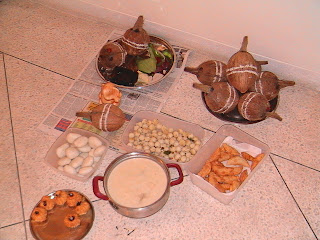
I was to have the pooja with a 100 coconuts today, but considering I barely know 20 people in all that I can give the vayan to. So, I'm going with five.


Traditionally, patolis or patolyo are made for Gowri Pooja by steaming a liquidy batter within a turmeric leaf. Vee has a complete pictorial here. I had neither banana leaves nor turmeric leaves available, so I decided to make steamed nevryo.


I followed Latha's recipe for the outer covering as I wanted to cut down on the coconut usage. (The amchi version that is similar to this has coconut in the outer covering as well as inside.) They didn't quite turn out the way I'd expected. But this was my very first time.


I made the stuffing the amchi way after referring to the book Rasachandrika.


Ingredients:

For the outer covering:

1 cup Rice Flour
1 cup Water
2 tsp Oil
Salt to taste

For the stuffing:

2 tbsp Sesame Seeds
6 tbsp Jaggery
12 tbsp Coconut, scraped
a pinch of Cardamom Powder


Bring the water to a boil in a heavy pan. Add the oil, salt and rice flour and stir well. Take off the flame and mix to a smooth dough like consistency. Cover and cool.


Toast the sesame seeds in a small pan. Add the coconut and jaggery and mix well. Take off the flame and add the cardamom. Keep aside.


Make small balls of the rice flour mixture and flatten it into a circle. Place some stuffing in the centre and fold over and seal the edges so you have a semi circle.


Steam in a pressure cooker without the weight for 3-4 minutes.


Since I had a problem with the covering dough, my patolis cracked and weren't exactly matching the visions I had of them. I didn't know what to do. I toyed with the idea of making open patolis on the lines of mini pizzas, but was too scared. So, I made something I was meaning to do for ages.


I remembered Laavanya's Ammini Kozhukattai. I made small balls out of my dough and steamed those. I mixed that with my poornu (stuffing) instead of her savoury seasoning.

I also made Narlya Kheeri for today's naivedyam. This is also known as Cheppi Kheeri (bland kheer) or Dhavi Kheeri (white kheer). It is traditionally made without any salt, especially today. But Amma always adds salt to this preparation. I was waiting for an opportunity to make this and today seemed perfect.


1/2 cup Rice
200ml Coconut Milk
Salt to taste
1 Turmeric Leaf


Cook the rice with plenty of water and the turmeric leaf. When cooked, add the coconut milk and salt to taste.


I made a simple spinach curry to go with this rice.


1 bunch Spinach, cooked and chopped
Grind to a paste:


2 tbsp Coconut, scraped
2 Red Chillies (Bedgi)
1 tbsp Tamarind Paste
Salt to taste


For the tempering:

1 tsp Oil
1/4 tsp Mustard Seeds
1/4 tsp Asafoetida
7-8 Curry Leaves

Heat the oil in a kadhai. Add the mustard seeds and asafoetida. When the mustard splutters, add the curry leaves. Add the spinach and the masala and mix well. Cook for 5 minutes.
I finished my pooja before lunch and in the evening pulled out one of the sarees from my wedding that I'd never gotten a chance to drape. I wanted to release all my sarees in my first year of marriage and this was the last. (Just 4 days before we complete a year!) We went to our friend's place across the street for a pooja and dinner.


This also goes to dear Asha as yet another entry for the RCI Karnataka event. As Chavati (Ganesh Chaturthi) is never celebrated without celebrating Teyi (Gowri Tritiya), I am sending this to Latha for her Gowri Ganesh event.

Thursday, September 13, 2007

Divkadgye Phodiyo (Breadfruit Fritters)


Bread fruit. I am not sure how many of you have actually heard about this fruit/vegetable, let alone seen/eaten it. There is a tree in the garden of my maternal grandparents in Matunga that yields this fruit. Bread fruit or divkadgi in konkani is a cousin of jackfruit (kadgi) and you can read more about it here.


I have not taken these pictures. I did a google image search for breadfruit and these emerged from there. I saved the pictures and so can't remember the sites from where I got them.


The picture above shows a cut breadfruit and the one below shows fruit on a branch. Since finding a tree or the fruit is a rarity, Amma used to get excited whenever she spoted either. And over the years, she has successfully managed to transfer that excitement to me.


I mentioned earlier that I am not too good at transliteration. I just read somewhere that this is also called jeevkadgi. To me it has always been divkadgi.


I had a chance to relish these deep fried beauties during my trip home a couple of weeks ago. Amma had brought a fruit from Bombay and I brought back half the fruit to Gurgaon as I was certain S had no idea what this fruit was and this would be chance to get him to enjoy something I have loved.


But I have had to eat these in moderation. Not just because they are deep fried food, but because breadfruit gives me a stomach ache in addition to being the gassy vegetable that it is. To counter this, I have asafoetida tablets immediately after my meal or drink buttermilk with loads of asafoetida.

1/2 small Breadfruit, peeled
1 1/2 tsp Asafoetida
2 tsp Chilli Powder
1 tsp Turmeric
2 tbsp Rice Flour
Salt to taste
Oil for frying


Cut the breadfruit lengthwise in 2 pieces. Cut each piece in 2 cm thick slices. You will be left with triangles like the ones in the picture.


Sprinkle the salt, asafoetida, turmeric and chilli powders over the pieces and mix well. Leave aside for 10-15 minutes.


Heat the oil in a kadhai.


Sprinkle the rice flour over the breadfruit pieces and make a coating of sorts. Deep fry the pieces in the oil and drain on a paper towel.


Enjoy these on the side with your main meal, as a starter or a snack.


The frying was done at Amma's place. When I was back in Gurgaon, I tried to follow the same procedure. Instead of frying, I smeared some oil over the pieces and baked them at 220 C for 10 minutes on each side. They didn't taste as great as the deep fried ones, but they weren't bad at all. We still enjoyed every piece along with our wine.


Off this goes to dear Asha as yet another entry for the RCI Karnataka event.

Wednesday, September 12, 2007

Chow Chow


Every cuisine probably has at least one dish that helps people use up leftover vegetables. Avial is the first thing that comes to mind. Chitrapur Saraswat cuisine is no different.

Chow chow: it means different things to different people. In Bangalore, you get Chow Chow Bhat. It is a serving of upma and kesari on a plate and is immensely popular as a breakfast item at the numerous Darshinis across the city.

Chow chow is the other name for the Chayote Squash. Also known as Marokkai, Bengaloor Katrikkai or Vilayat Vaingan.

Chow chow to me means all of these and more. How much more? Read on and you'll find out.


This is also what it means to me: A mixed vegetable dish with a pickle gravy. The masala is the same one that is used in amchi pickles. So, this is one of those fiery dishes. And to add more tingle to your already tingling taste buds, actual pickle is added to this dish. When you have leftover pickle, mostly gravy and all pieces gone, you add some water and wash the bottle and add all that to the dish. Can you believe that?

I asked Amma why this recipe, which is a regular feature in most amchi homes, is not featured in Rasachandrika, the popular amchi cookbook. She told me that it wasn't that old a dish. Apparently, a well known cook/chef/caterer created this at a wedding and it became an instant hit. (I am sure even he had leftover vegetables he had no clue what to do with!)


Ingredients:

2 Potatoes, boiled, peeled and cubed

2 small Carrots, cut into 2" long pieces

100g Beans, cut into 2" long pieces

6 medium Brinjals, quartered lengthwise

2 tbsp Tamarind Paste

2 tbsp Red Pickle Gravy (optional)


For the masala:

1 tsp Oil

1/2 tsp Mustard Seeds

1/2" piece Asafoetida (or 1/2 tsp Asafoetida Powder)

1 tsp Pepper

1 tsp Fenugreek Seeds

3-4 Red Chillies

3 tbsp Coriander Seeds

1/2 tsp Turmeric Powder

1/4 cup Coconut, scraped

Salt to taste


For the tempering:

1 tbsp Oil

1/4 tsp Mustard Seeds

1/4 tsp Asafoetida

7-8 Curry Leaves


Cook the carrot and beans in a pressure cooker.


In a small kadhai, heat 1 tsp of oil and add the mustard seeds, asafoetida, pepper, fenugreek seeds, red chillies and coriander seeds. Roast these ingredients for a few minutes. Cool and grind together with the coconut and turmeric powder.


In a larger kadhai, heat 1 tbsp of oil. Add the ingredients for the tempering. When the mustard splutters, add the brinjal pieces and fry well. Add the tamarind paste and salt. Cover and cook for a few minutes till the brinjal becomes soft. Add the potatoes, carrots and beans along with the ground masala to the brinjals. Add the pickle gravy now, if using.


Cover and cook for 4-5 minutes. Serve with chapatis or rice and dali saar. I enjoyed it with rice rotis as well.


This is a super hit with anyone who has eaten it. My friend was visiting when this was made and she took a box back home. Apparently, it was not just she who'd fallen in love with the dish. Her folks at home loved it too and at her request comes this much loved amchigele recipe. Bee: this one is for you too. I hope you enjoy this.


And last, but not least in any way, this is also for dearest Asha as yet another entry for the RCI Karnataka event.

Tuesday, September 11, 2007

Dali Saar


I have talked endlessly about my mixed parentage and to some extent about dali saar too. Growing up in Madras, we had different cuisines arrive at the dinner table or in the lunch box. The variety did not include global foods the way it does today (Chinese, Thai, Lebanese, etc), but we had quite a spread.


On a typical day, we'd see the sambar-rasam routine or the dali saar-masla randeyi routine. For some reason, I formed a strong bond with rasam and discovered a love for dali saar. Sambar (which S loves) and I are civil and even friendly at times, but the love affair really hasn't taken off.


Dal is an integral part of konkani cuisine and appears on the table in several forms, the most popular ones being dali saar and dali toy. The preparation is pretty much the same and the former is a little more liquidy than the latter. Given my fixation on rasam, it is anyone's guess which version I love.


This is one dish that comes to the rescue on many weeknights.


1/2 cup Toor Dal

1 tsp Green Chilli Paste

1 tsp Ginger Paste

Salt to taste

A pinch of Turmeric Powder (optional)


For the tempering:

1 tsp Oil or Ghee

1/4 tsp Mustard Seeds

1/4 tsp Asafoetida

7-8 Curry Leaves

1 Red Chilli or 1 tsp Chilli Flakes


Pressure cook the toor dal with the chilli and ginger pastes (and turmeric, if using) and 1 1/2 cups of water. Alternatively, you can cook the dal with a couple of slit green chillies and a 1" piece of chopped ginger.


When cooked, beat the dal well and add another cup of water. Add the salt and bring the mixture to a boil.


In a small kadhai, heat the oil or ghee, add the mustard seeds and asafoetida, and when the mustard splutters, add the red chilli and curry leaves. Add this to the dal mixture.


Serve hot with rice and a kosumbari or crisps on a busy day or make an elaborate meal with sheet (rice), dali saar or dali toy (dal), upkari (steamed vegetable) or talasani (fried or roasted vegetable), masla randeyi (coconut gravy item), kosumbari (salad) and dhayi (curd) or taak (buttermilk) and phodiyo when you have the time.


This is off to dear
Asha for the RCI Karnataka event.

Monday, September 10, 2007

Strawberry Fizz


Ice cream sodas! I'd read about them all the time while growing up. Archies and his gang are always at Pop Tate's having ice cream sodas. For some reason, I didn't ever have them when I was in the U.S. Or maybe I had them and didn't realize what I was having.


I fell in love with the concept and the drink at a place called "Shakes & Creams" in Madras. Ever since, I make them at every opportunity. (The opportunities come very rarely as we never have ice cream or sodas ready at home!!)


Some time ago, I had everything at home. (Soon after we had a houseful of guests for dinner.) So, I was able to enjoy this drink on a weekend. While this drink can be made with about 30 ml of vodka as well, I made it good old fashioned kiddies' way.


For one glass I used:


1 tbsp Strawberry Crush
200 ml Sprite/Plain soda
1 scoop Vanilla Ice cream


Pour the strawberry crush in a glass. Drop the ice cream over it. Pour the Sprite over this. Stir everything together and enjoy it on a hot day.


This is my entry to Meeta's Monthly Mingle. This month's theme is Liquid Dreams.

Sunday, September 9, 2007

Capsicum Phodiyo (Capsicum Fritters)


This is one more of the fried goodies that come to the table once in a while at my place. This has been a hit at dinners at my parents' place and I also end up making these along with the Cauliflower Phodiyo.


It is tough to believe that something so simple can taste so good. And whenever Amma made them, I would be asked to taste. It is anyone's guess how many I "tasted" before certifying them as very good.


Ingredients:


2 Large Capsicum, cut into rings


1 tsp Chilli Powder


1/2 tsp Turmeric Powder


2 tbsp Curd


2 tbsp Gram Flour


Salt to Taste


Oil for deep frying

Mix the salt, chilli powder, and turmeric powder together and make a paste using the curd. Apply this to the capsicum rings like a marinade and leave aside for 10-15 minutes. Alternatively, you can place all the ingredients (including the capsicum rings) in a vessel and mix them.

Heat the oil in a kadhai.

The capsicum mixture will have released some water by this time. Add the gram flour to the mixture so that it absorbs the water and mix well.

Deep fry the rings in the oil and drain on a paper towel.


Enjoy them while hot. You'll know what living the good times is all about. This is off to dear Asha for the RCI Karnataka event.

Friday, September 7, 2007

Cauliflower Phodiyo (Fried Cauliflower)


A traditional amchi meal would have sheet (rice), dali saar or dali toy (dal), upkari (steamed vegetable) or talasani, masla randeyi (coconut gravy item), kosumbari (salad) and dhayi (curd) or taak (buttermilk). And then there are papads, vadiyo, and phodiyo. Papad could be the usual urad papads or the special chilli papads. Vadiyo are prepared in the summer and give us endless moments of happiness during the other months.

Phodiyo (plural for Phodi) are made with fresh vegetables. These are not to be confused with Bajey which are like the bajjis of Tamilnadu or the pakoras of the North. While bajeys are coated with gram flour batter and deep fried, phodiyo are smeared with spices and then deep fried. With bajeys you run the risk of leaving the vegetable uncooked, but with phodiyo, there is not the slightest chance.


These cauliflower crisps are very unusual and everytime they are made (which is rare to start with) they disappear before I can get to them.


1 cup Cauliflower florets

1 tsp Chilli Powder

1 tsp Cumin Seeds

1/2 tsp Turmeric Powder

2 tsp Lime Juice
2 tbsp Gram Flour
Salt to Taste
Oil for deep frying


Mix the salt, chilli powder, turmeric powder and cumin seeds together and make a paste using the lime juice. Apply this to the cauliflower florets like a marinade and leave aside for 10-15 minutes. Alternatively, you can place all the ingredients (including the cauliflower florets) in a vessel and mix them.


Heat the oil in a kadhai.


The florets will have released some water by this time. Add the gram flour to the florets so that it absorbs the water and mix well.


Deep fry the florets in the oil and drain on a paper towel.


Enjoy these as snacks on a rainy day, as an accompaniment to your meal or serve them as starters when you have guests. Better still, have these ready when you sit down for a drink on leisurely evening. These will take you to heaven before you even say "yummy!"


I intend to try and bake these "Nupur style" the next time I make them.


This is off to dear
Asha for the RCI Karnataka event. Now you all know why she had to get her eyes fixed before this event. I have started to flood her mailbox and we're less than 2 weeks into the event.

Thursday, September 6, 2007

Akki Roti


I still remember the day when I ate this for the first time. I was staying with my uncle and aunt in Bangalore. And the daughter-in-law of their very close friend was to come home and teach my aunt how to make this. She had learnt this from her North Karnataka friends and had mastered it.


After that session, Akki Rotis became a regular feature at my aunt's place as well as mine. It is now a regular even at Amma's place. I had posted this once before in a different avatar. Here's the original recipe.


1 cup Rice Flour

2 tsp Green Chilli paste (or 2-3 Green Chillies, finely chopped)
1/4 cup Coconut, scraped
2 tbsp Oil
1/4 cup Coriander, chopped
2 Onions (or half a bunch of Spring Onions), finely chopped
Salt to taste
Oil for frying


Mix all the ingredients together (except the oil for frying!!) and add some water to make it a thick dough. (This is not a batter, it should resemble shortcrust pastry or chapati dough and not dosa batter.) Make small balls of this dough and flatten them on a greased plastic sheet.

Place the flattened dough on a hot tawa and toast evenly on both sides. This is also meant to be enjoyed with a dollop of butter. We enjoyed it with some Aavakaya.

A very traditional recipe from Uttara Kannada goes to Asha as one of the non Dakshina Kannada recipes for the RCI Karnataka event.

Wednesday, September 5, 2007

Chocolate Chip Buns


Janmashtami is a very important festival for us. At my mother's family home in Bombay, there are Bhajan sessions each evening for 8 days and not just the family, but the entire neighbourhood gets together to sing. Everyday, the idol of Krishna is dressed in a different form and there is a different Prasad each evening. On the last day, the children come dressed as Krishna and the Gopis and they get little treats from everyone.


At my parents’ place, Srijayanti is celebrated on one day and it is all about food, really. Fruits, savouries and sweets. I wanted to try out a sweet dish today. I thought about several things. My friend Prajakta said she’d
come visiting with her daughter and offered to bring some kheer. The traditional sweet dish had been taken care of. Though I've always wondered how these traditions have come to be. Who decided that Krishna likes only seedai or aval? We were told that and we accepted it. I thought that if the Dashavatars had existed in this day and age, Krishna would have loved Cadbury's just as much as he enjoyed butter.


God does exist everywhere. And on a festival such as Janmashtami, when children don beautiful costumes and become little Krishnas and Gopis, I decided to make a little something that kids would love. And since it has no egg, onion or garlic, even traditionally speaking, it becomes worthy of being offered as naivedyam. The little one who came dressed as a Gopi yesterday to my place was dressed as Krishna the day before. So, here's my little treat for dear little Krishna on his birthday.


Ingredients:

1 1/2 cups Flour
1 1/2 tbsp Yeast
1 1/2 tbsp Oil
1 1/2 tbsp Sugar
3/4 tsp Salt
2 tbsp Chocolate Chips
1/4 cup Milk
1/4 cup Boiling Water
Oil for greasing bowl and baking tray
Coloured sugar confetti for decoration


Take a huge mixing bowl and place the oil, salt and sugar in it. Add boiling water and mix until the sugar dissolves. Add the milk now to bring the mixture to room temperature. Add the yeast and mix well. Add the flour, chocolate chips and 1 tbsp of cocoa butter icing and knead into a dough. Place the dough in a greased vessel and cover it with a damp muslin cloth. Allow to rise until double in size (roughly 45-50 minutes).

Knead the dough for a minute on a floured surface and then divide into 16 - 20 equal rounded portions and place them on a greased baking tray.

Allow to rise for 50-60 minutes and then bake in an oven at 400 F for 12-15 minutes.

When the buns are cool, spread a little cocoa butter icing on each and sprinkle with sugar confetti.

This is the stuff that dreams are made of. This was my first attempt at making sweet buns. The flavour was very similar to that of a chocolate doughnut and we could eat it with about 80% less guilt. Some of the buns have gone into the little one's tiffin for today and were also eaten for breakfast by S and his colleagues.

My first Janmashtami celebration cooking was a success. I'm sending this to Latha for her Janmashtami event. These buns were ideal for a breakfast on the go and I made them using left over Cocoa Butter Icing from S's birthday cake. So this is also my entry to the Weekend Breakfast Blogging # 15, the theme of which is Breakfast using Leftovers. WBB is the brainchild of Nandita of Saffron Trail and, after doing the rounds of different guest hosts' blogs, has come back to the Saffron Trail this month.

Yesterday was also the birthday of a very dear friend. Aarti: as promised, these are for you.

Tuesday, September 4, 2007

Poori Bhaji


Anita had invited all of us to a party. But I couldn't attend it. I was busy with guests at home and then I was off to Mukteshwar. When I returned, I had to tend to S and then it was time to travel yet again. I was off to Madras and then to Kallakurichi to attend a wedding. Since I was going via Madras, I extended my stay a bit so I could spend my parents' 44th anniversary with them. And I also jumped at Amma's suggestion of poori bhaji at breakfast.

I have never been able to eat pooris for breakfast. It was regular breakfast at my place when I was growing up. We'd probably have it once or twice a month. And it was Friday morning breakfast at hostel too. I once told a Punjabi friend that most Tamilians would think of Poori as a Tamil dish. Wherever you may go in Tamilnadu, from the big cities to the smallest of towns or villages, this one item is a must-have on the menus of eateries. You'll get pooris starting from 4 or 5 in the morning. And I remember when I was studying in Pondicherry, you'd get 2 pooris for 5 rupees if you wanted potato bhaji, but if you were willing to have it with sambar, you'd get 3 pooris for the same price.


I have never(save one instance) attempted to fry pooris. The closest I have come is biscuit rotis. This time was no different. I stood next to Amma as she rolled the pooris and I fried them. There is a technique to frying pooris. You drop the first one in hot oil. When it puffs up, you turn it and then drop the next one. When the second one puffs up, you turn that and then remove the first one from the oil. And then add the third. This timing works very well and all the pooris turn out to be evenly brown. Now, that's expertspeak!


Pooris:

1 cup Wheat flour
A pinch of salt
2 tbsp oil
Water to make the dough
Oil for deep frying

Bhaji:

4-6 Potatoes, boiled
1 Onion, finely chopped
1 Tomato, finely chopped
1 tbsp Oil
1/4 tsp Mustard Seeds
1/4 tsp Asafoetida
1/4 tsp Turmeric Powder
1 tsp Chilli paste
1/2 tsp Ginger paste
7-8 Curry Leaves
Salt to taste

To make the pooris:
Mix the salt with the oil and add the wheat flour to this misture. Add enough water to make a firm dough. This must be significantly harder than the dough that is made for phulkas. Make small balls of the dough.

Heat oil in a kadhai.

Dip each ball in the hot oil and then roll into a small circle on the work board. This ensures easy rolling without the use of flour.

Fry these circles in the hot oil in the manner described above. Drain the excess oil in another kadhai and transfer the pooris to a dish lined with a paper towel.


For the bhaji:


Heat oil in a pressure pan. Add the mustard seeds and asafoetida. When the mustard splutters, add the curry leaves. Add the onions, chilli and ginger pastes, turmeric powder and fry for a couple of minutes. Add the tomato and salt and fry for another minute. Add the boiled potato pieces and water and cook for 1-2 whistles.


When the pressure is released, open the pan and mash the potato pieces lightly with the back of the spoon.


Serve the pooris along with the bhaji and enjoy the meal with your family. Just as I did. It brought back so many memories. Thanks Anita.

Monday, September 3, 2007

Rulaama Doddak (Thick Rava Dosa)


This post comes in a month after I actually prepared the dish. How do I remember the date? It was S's birthday on the 3rd of August and I made these doddaks for breakfast. (Rulaam is Rava/Sooji in Konkani. Doddaks are thick dosas that are prepared by pressing the dough on to a hot griddle instead of spreading with a ladle. Sometimes, I make them by spreading too. So now you know that I'm no expert!!)


This is a really simple snack. No soaking no fermentation. This used to be weekend breakfast when we were growing up as each doddak takes a little while to crispen nicely.


Ingredients:


1 cup Cream of Wheat

1/4 cup Coconut, scraped

1/4 cup Coriander, chopped

Salt to taste

Oil for frying


For the tempering:


1 tsp Oil

1/4 tsp Mustard Seeds

1/4 tsp Cumin Seeds

1/4 tsp Asafoetida

7-8 Curry Leaves


Prepare the tempering in a small kadhai and transfer the contents to a mixing bowl. Add the remaining ingredients except the oil and mix well using a little water. (Do not add too much water. The batter should not be watery.)


Pat the dough onto a hot griddle and pour a few drops of oil on all sides. Make a slit in the centre using the spatula and pour a few drops into this slit. (This helps the oil reach the centre and aids in crispening that portion.)


Turn over and allow the other side to crispen as well. Serve with pitti chitni and toop (dry roasted gram chutney and ghee).


As kids, we used to gobble these up with a dollop of fresh home made butter. And we would attempt to finish eating the doddak before the butter melted entirely. I still indulge in this every once in a while, but I stick to having it with the pitti chitni and groundnut oil most of the time.


I waited all this while so I could send this entry to Asha for the RCI Karnataka event.

Saturday, September 1, 2007

Besan Unde and Many Happy Returns


Celebrations. Incomplete without sweets in our country. When we think about Kucch Meetha Ho Jaaye, this is what we make.


Ingredients:


1 cup Gram Flour

1/2 cup Wheat Flour

1 cup Powdered Sugar

3/4 cup Ghee (Clarified Butter), more or less depending on the need

5-6 Cardamom, powdered

1/4 cup Raisins

1/4 cup Cashewnuts

A pinch of Nutmeg powder

Ghee for frying


Heat the ghee in a kadhai and fry the besan until the aroma fills your kitchen. Transfer to a large plate. In the same kadhai, without adding any extra ghee, roast the wheat flour. Mix this with the besan paste.


In another small kadhai, heat some more ghee and fry the raisins and cashews. Add these to the besan-wheat flour mixture. Add the cardamom powder and nutmeg powder along with the powdered sugar.


Mix well and form small balls. This is a lovely treat for you and yours to enjoy.


Today is my parents' 44th wedding anniversary and I wanted to share a really special treat with all of you. I am so happy to be able to spend today with them and am ever so grateful that I got them as parents. My world is a better place thanks to them.


Amma & Appa: wishing you every happiness.

And off this goes to dear Asha for the RCI Karnataka event.